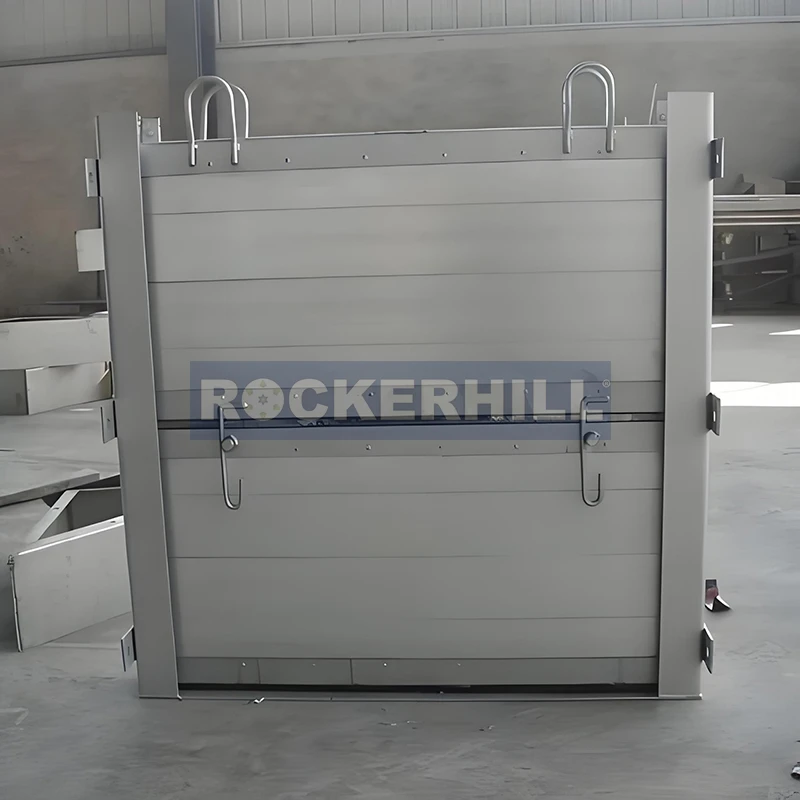

Stop logs for water control are modular, removable barriers composed of individual horizontal or vertical panels (typically made of steel, aluminum alloy, or reinforced composites), designed to be stacked in preinstalled guide frames to regulate, block, or divert water flow in dams, canals, pipelines, or reservoirs. Their temporary nature makes them ideal for short-term water management needs-such as maintenance, construction, or emergency flow control-allowing for flexible deployment and removal as project requirements change.
Key Advantages of Stop Logs for Water Control
1. Modular Flexibility
o Panels are stacked to achieve desired height (e.g., 5–10 panels for 3–6m water depth), enabling precise adjustment of flow rates or water levels.
o Easy to add/remove panels to adapt to changing conditions (e.g., seasonal rainfall or maintenance phases).
2. Cost-Effective Deployment
o Lower upfront investment compared to permanent gates (e.g., bulkhead gates), as they share a single guide frame for repeated use.
o Minimal installation infrastructure required-guide frames can be retrofitted into existing structures (concrete walls, steel channels).
3. Rapid Installation & Removal
o Lightweight materials (e.g., aluminum alloy panels) allow manual handling or use of small cranes, reducing deployment time to hours (vs. days for permanent systems).
o Critical for emergency scenarios (e.g., flood response or pipeline leaks) where quick water diversion is needed.
4. Material Versatility
o Steel logs (carbon steel with coatings) for high-strength applications (e.g., dams with 10+ m water head).
o Aluminum alloy logs (6061-T6) for corrosion resistance in freshwater/coastal areas (e.g., irrigation canals, tidal zones).
o Composite logs (fiberglass-reinforced polymer) for extreme corrosion environments (e.g., industrial wastewater).

Structural Features of Stop Logs for Water Control
Panels:
o Rectangular or trapezoidal shape (1–3m width, 0.5–1.5m height) with reinforcing ribs to withstand hydrostatic pressure.
o Edge profiles designed for interlocking (e.g., tongue-and-groove) to minimize leakage between panels.
Guide Frames:
o Vertical steel or concrete rails (spaced to match panel width) with low-friction liners (nylon, PTFE) to ensure smooth panel insertion/removal.
Sealing Mechanisms:
o Rubber gaskets (EPDM or neoprene) along panel edges to reduce leakage (typically ≤1 L/s per meter of panel length).
o Some designs include compression bars to tighten seals under high pressure.
Lifting Components:
o Integrated lifting lugs or eyebolts (rated for panel weight + safety margin) for secure handling with hooks or slings.
Types & Applications of Stop Logs for Water Control
|
Type of Stop Log |
Material |
Key Use Cases |
|
Steel Stop Logs |
Carbon steel (with epoxy/zinc coating) |
High-pressure scenarios: dam outlets, large rivers |
|
Aluminum Stop Logs |
6061-T6/7075-T6 alloy |
Freshwater/coastal areas: irrigation canals, tidal barriers |
|
Composite Stop Logs |
Fiberglass-reinforced polymer (FRP) |
Corrosive environments: industrial wastewater, chemical plants |
Primary Applications
- Temporary dewatering of pipeline sections for repair or inspection.
- Regulating flow in irrigation canals to distribute water to farmland.
- Blocking water in dam spillways during maintenance of turbines or gates.
- Creating temporary reservoirs for construction projects (e.g., bridge foundations in rivers).
Technical Considerations for Stop Logs in Water Control
Water Head Limits
Aluminum logs: Up to 10m (due to lower tensile strength).
Steel logs: Up to 20m (with reinforced edges for higher pressure).
Composite logs: Up to 15m (depending on fiber reinforcement).
Corrosion Management
Steel logs require regular coating maintenance (every 3–5 years) in moist environments.
Aluminum/composite logs are self-protective but may need periodic cleaning to remove debris buildup.
Safety Factors
Panel weight must be matched to lifting equipment (e.g., a 2m steel panel weighs ~200kg, requiring a 500kg-capacity crane).
Guide frames must be anchored securely to prevent displacement under lateral water pressure.
Stop Logs vs. Permanent Water Control Structures
|
Aspect |
Stop Logs for Water Control |
Permanent Gates (e.g., Bulkhead, Sluice) |
|
Use Case |
Temporary/seasonal water control |
Long-term, continuous isolation |
|
Cost |
Lower (50–70% of permanent systems) |
Higher (includes actuation hardware, foundations) |
|
Flexibility |
Easy to reconfigure (add/remove panels) |
Fixed design, limited adjustability |
|
Installation Time |
Hours to days |
Weeks to months (requires construction) |
In summary, stop logs for water control are a practical, adaptable solution for temporary or semi-permanent water management, offering a balance of cost, speed, and versatility across agricultural, industrial, and civil engineering applications.
Hot Tags: stop logs for water control, China stop logs for water control manufacturers, suppliers, factory