|
TECHNICAL DATASHEET | WATER INTAKE SCREENING Traveling Water ScreenThrough-flow and dual-flow band screens for river, seawater and cooling water intakes |
|
What is a traveling water screen? A traveling water screen, also called a travelling band screen or band screen, is a continuous loop of mesh panels that filters raw water at an intake. It lifts debris out of the flow and washes it off at the discharge point, protecting pumps, condensers, heat exchangers and downstream treatment from fouling and damage. Through-flow and dual-flow designs Mesh opening 1 to 10 mm SS304, SS316L and duplex materials Custom channel width and lifting height |
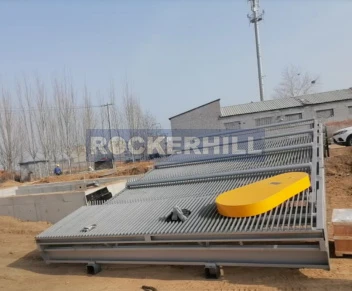
Rockerhill traveling water screens, assembled and tested in the workshop. |

|
Key facts |
|
|
Also known as |
Band screen, travelling band screen, travelling water screen, through-flow screen, dual-flow screen |
|
Main function |
Continuous removal of debris, vegetation, fish and marine growth from the water at an intake |
|
Typical sites |
Power plant cooling water intakes, seawater desalination intakes, river and lake raw water intakes, industrial process water |
|
Manufacturer |
Rockerhill Global Limited, China (established 2011), 17,000 m2 manufacturing hub in Jiangsu, 18-month warranty |
Built in our workshop
|
Screen frames in fabrication. Heavy steel frames and mesh sections are built to the channel drawing. |
Chain and sprocket drive. Sprockets, chain and gear motor are assembled and aligned before shipment. |


Construction at a glance
|
|
|

Figure 1. Side elevation of a traveling water screen (schematic, not to scale). Arrows show the flow of water through the mesh.
How a traveling water screen works
|
1 |
Water passes through the mesh Raw water flows toward the intake. Debris larger than the mesh opening is held on the face of the mesh panels. |
|
2 |
The band rotates The drive unit moves the chain and mesh panels upward, carrying the retained debris out of the water. |
|
3 |
Panels are washed At the head section, the spray wash header cleans each panel while the debris falls into the trough. |
|
4 |
Screenings are discharged Washed debris flows to a trough or conveyor for disposal, and the clean panels return down into the channel. |
|
5 |
Control starts the cycle A timer or a differential water level sensor starts or speeds up the drive when the mesh begins to clog. |
Through-flow vs dual-flow traveling water screens
The two common arrangements differ in how water passes through the screen band. Dual-flow designs use both runs of the band, which gives more screening area in the same channel width.
|
Item |
Through-flow |
Dual-flow |
|
Water path |
Water passes through the ascending run of the band in a single pass |
Water uses both the ascending and descending runs of the band |
|
Screening area |
Standard for the channel width |
Larger for the same channel width |
|
Best for |
Moderate flows, moderate debris loads, simpler civil works |
Higher flows, limited channel width, heavier debris loads |
|
Typical sites |
River and lake intakes, industrial water |
Power plant cooling water, large seawater intakes |
Traveling water screen vs bar screen
A bar screen removes large debris first. A traveling water screen then removes finer debris and is usually installed behind it at water intakes.
|
Item |
Bar screen (coarse) |
Traveling water screen |
|
Role |
First-stage protection against large debris |
Second-stage fine screening of the intake flow |
|
Element |
Fixed parallel bars with a raking mechanism |
Continuous band of mesh panels |
|
Typical opening |
Larger, commonly 10 mm and above |
Smaller, commonly 1 to 10 mm |
|
Typical use |
Pumping stations, plant inlets, trash protection |
Cooling water, desalination and raw water intakes |
Related Rockerhill pages: Band Screen | Bar Screen | All screens
Installation layout
Rockerhill engineers the screens together with the debris troughs and conveyors, so the full discharge route is designed in 3D before fabrication.

Figure 2. 3D layout of two screens with discharge troughs and conveyors over an intake channel.
Applications
|
Application |
Typical duty |
Design notes |
|
Power plant cooling water |
Protects condensers and heat exchangers from debris and marine growth |
Dual-flow designs for large flows |
|
Seawater desalination intake |
Pretreatment ahead of pumps, filters and reverse osmosis |
Duplex or 316L materials against corrosion |
|
River and lake raw water |
Protects pumps at water treatment plant intakes |
Handles leaves, branches, vegetation and silt |
|
Industrial process water |
Steel, petrochemical, pulp and paper, mining |
Mesh and materials matched to the process |
|
Hydropower and irrigation |
Keeps trash from turbines and canal gates |
Often combined with trash racks and gates |
|
Aquaculture |
Separates solids from recirculating or intake water |
Fine mesh and fish-friendly design |
Technical specifications
Typical design ranges for traveling water screens. Each unit is sized for the project, so final values are confirmed in the quotation.
|
Parameter |
Typical range |
Notes |
|
Channel width |
1.0 to 6.0 m |
Custom widths available |
|
Lifting height (channel depth) |
Up to about 30 m |
Set by water level range and deck height |
|
Mesh opening |
1 to 10 mm |
Finer meshes down to 0.2 mm for fine filtration |
|
Through-screen velocity |
0.5 to 1.0 m/s |
Design value at the lowest water level |
|
Band speed |
2 to 10 m/min |
Fixed or variable, depending on the debris load |
|
Head loss across the screen |
Typically below 0.3 m |
Clean mesh, design flow |
|
Drive power |
1.5 to 15 kW |
Motor and gear reducer, with overload protection |
|
Spray wash pressure |
3 to 10 bar |
Wash pump supplied or by the owner |
|
Control |
Timer and differential level |
Local panel, remote signals optional |
|
Frame and chain materials |
SS304, SS316L, duplex, coated carbon steel |
Select by water quality and design life |
|
Mesh panel materials |
Stainless steel wire mesh, polymer mesh |
Stainless steel is typical for seawater |
Options: fish return trough, debris conveyor, stop log or gate slots, shear pin or torque overload protection, heating for cold climates, explosion-proof motor, protective cover, and installation support.
Information needed for a quotation
Send these data points and our engineers can propose a model, a layout and a price.
|
1. Water source: river, lake, seawater or cooling water |
6. Debris type: leaves, branches, plastics, fish, marine growth |
|
2. Design flow rate (m3/h) and number of screens |
7. Material requirement: SS304, SS316L or duplex |
|
3. Channel width and depth, in mm or as a drawing |
8. Installation: indoor or outdoor, climate range |
|
4. Highest and lowest water level, and deck elevation |
9. Power supply (voltage and frequency) and control needs |
|
5. Required mesh opening (mm) |
10. Delivery location, and any standards or documents required |
Frequently asked questions
What is a traveling water screen used for?
It filters raw water at an intake. It removes debris, vegetation, fish and marine growth before they reach pumps, condensers or treatment equipment.
What is the difference between a traveling water screen and a band screen?
They are the same machine. Traveling water screen is the common term in power and water intake projects, and band screen is the common term in wastewater and treatment.
Through-flow or dual-flow: which should I choose?
Through-flow suits moderate flows and debris loads. Dual-flow gives more screening area in the same channel width, so it suits higher flows and heavier debris.
What mesh size is used for a water intake?
Most intake screens use 1 to 10 mm. The final opening depends on the debris, the equipment being protected and any fish protection rules.
Which material is suitable for seawater?
Stainless steel 316L or duplex stainless steel, with matching fasteners and coatings. The final choice depends on water quality and design life.
How is debris removed from the mesh?
As the panels rise above the water, the spray wash header washes the debris into a trough or conveyor for disposal.
What information do you need to quote a traveling water screen?
Please send the water source, design flow, channel width and depth, water levels, required mesh opening, material and power supply. The full list is on the previous page.
|
Request a quotation Rockerhill Global Limited is a China-based manufacturer of mechanical screens, gates and water treatment equipment for water intake and wastewater treatment. Established in 2011, with a head office in Beijing. |
Website www.rockerhillcn.com Phone +86 010 64758010 WhatsApp +86 157 5752 3989 Email Allie.s@rockerhillcn.com Address Room 1722, Building 55, No.5 Yujing East Road, Tongzhou District, Beijing |
Hot Tags: traveling water screen, China traveling water screen manufacturers, suppliers, factory