


|
Illustrative render · typical ROCKERHILL screenings washer compactor |
||||||
|
35–50 % Dry solids after compaction (typical) |
Up to 75 % Reduction in screenings volume (typical) |
0.5–12 m³/h Screenings throughput across the range |
SS304 / 316L Stainless steel wetted parts |
|||
|
ROCKERHILL GLOBAL LIMITED WWW.ROCKERHILLCN.COM · ALLIE.S@ROCKERHILLCN.COM |
||||||

What is a screenings washer compactor?
A screenings washer compactor, also called a wash press or screenings wash press, is the standard partner for every mechanical screen at a wastewater treatment plant. Screenings removed by bar screens, step screens, rotary drum screens and band screens are wet, heavy and full of faecal matter. Sent straight to landfill, they smell, attract flies and cost money to haul.
The ROCKERHILL washer compactor takes these screenings directly from the screen, washes the organics back into the flow, drains the free water and presses the remaining material into a dense, cleaner plug. The result is screenings that are lighter, smaller in volume, easier to handle and suitable for bagging, skips or landfill.
Why plants add a washer compactor after the screen
|
■ Lower disposal cost Weight and volume are typically cut by 50–75 %, so fewer skip changes and lower landfill fees. |
■ Cleaner, more hygienic screenings Washing returns faecal matter and soluble organics to the treatment process instead of the skip. |
|
■ Less odour and fewer flies Washed, compacted screenings with low organic content are far less offensive around the headworks. |
■ One machine instead of three Washing, dewatering and compaction happen in a single enclosed stainless steel unit. |
|
■ Fits any ROCKERHILL screen Sized and interlocked with our bar, multi-rake, step, rotary drum and band screens, or fed by a shaftless screw conveyor. |
■ Simple to run and maintain Low-speed screw, few wearing parts, automatic wash cycles and easy access for inspection. |
How it works
Screenings fall into the inlet hopper. A slow-turning screw carries them through three zones in one housing, while timed spray water and the screw action wash out the organic fraction.

Process sequence
Feed
1
>>
Wash
2
>>
Dewater
3
>>
Compact
4
>>
Discharge
5
Main components
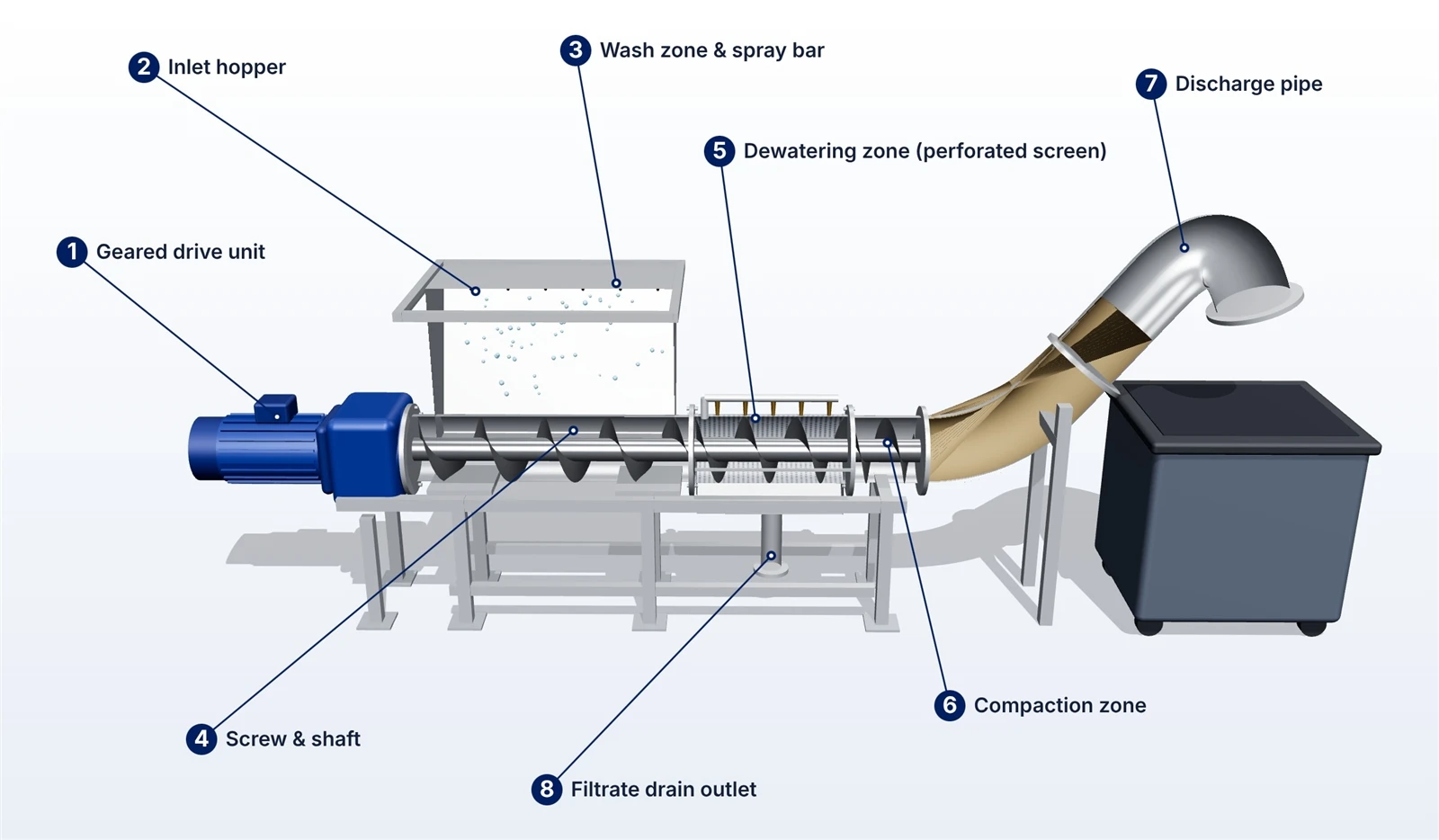
Illustrative cutaway: housing and hopper shown sectioned to reveal the screw and process zones
|
1 Geared drive unit Helical gear motor mounted directly on the screw. Sized for high starting torque, with overload or torque monitoring and automatic reversing to clear jams. |
2 Inlet hopper Stainless steel hopper sized to the screen discharge chute or conveyor. Flanged top for an odour cover or chute connection. |
|
3 Wash zone and spray bar Solenoid-controlled spray nozzles wet the screenings while the screw turns them over, releasing faecal matter and soluble organics. |
4 Screw and shaft Robust shafted screw with wear-resistant flights. Low speed for long service life and good washing. |
|
5 Dewatering zone Perforated stainless steel screen basket lets wash water and free water drain away as the screenings advance. |
6 Compaction zone The screw pushes material against the plug in the discharge pipe, building pressure and squeezing out more water. |
|
7 Discharge pipe Flanged stainless pipe, straight, inclined or gooseneck, to deliver compacted screenings to a skip, bin or bagger. |
8 Filtrate drain outlet Wash water, filtrate and organics are collected in the drain trough and returned to the channel upstream of the screen. |
General arrangement
Typical side elevation, plan and section through the hopper. Lettered dimensions change with model size and with the discharge layout. A project-specific GA drawing is issued with every quotation.

Drawing RH-SWC-GA-01: typical general arrangement (illustrative, not to scale)
Typical model range
|
Model |
Screw Ø (mm) |
Throughput (m³/h)* |
Motor (kW) |
Inlet B (mm) |
Length A (mm) |
Weight (kg) |
|
RH-SWC-200 |
200 |
0.5 – 1.5 |
1.5 |
800 |
3,200 – 3,800 |
≈ 450 |
|
RH-SWC-260 |
260 |
1 – 3 |
2.2 |
1,000 |
3,800 – 4,400 |
≈ 650 |
|
RH-SWC-300 |
300 |
2 – 5 |
3.0 |
1,200 |
4,200 – 4,900 |
≈ 850 |
|
RH-SWC-350 |
350 |
4 – 8 |
4.0 |
1,400 |
4,600 – 5,400 |
≈ 1,100 |
|
RH-SWC-400 |
400 |
6 – 12 |
5.5 |
1,600 |
5,000 – 5,900 |
≈ 1,400 |
* Loose screenings volume fed from the screen. Inlet height H, discharge height C and hopper width W are set to suit the screen and the skip.
|
To confirm before publishing: The model names, capacities, motor ratings, dimensions, weights and performance figures on this page are typical industry ranges for this type of machine. Please have ROCKERHILL engineering confirm or adjust them to match our actual designs. |
Design and performance data
|
Parameter |
Typical value |
|
Function |
Washing, dewatering and compaction of screenings in one unit |
|
Feed |
Bar, multi-rake, step, rotary drum or band screen; conveyor or manual feed |
|
Screenings throughput |
0.5 – 12 m³/h loose screenings, depending on model |
|
Dry solids at discharge |
Typically 35 – 50 % DS, depending on screenings type |
|
Volume and weight reduction |
Typically 50 – 75 % |
|
Organics washout |
Majority of faecal and soluble organics returned to the flow |
|
Screw speed |
Approx. 8 – 20 rpm |
|
Wash water |
Approx. 1 – 4 m³/h during wash cycle, 3 – 6 bar; plant effluent or potable |
|
Dewatering screen |
Perforated basket, Ø 3 – 6 mm holes |
|
Installation |
Horizontal or inclined, floor or platform mounted; indoor or outdoor |
|
Power supply |
380 – 415 V / 50 Hz or 460 V / 60 Hz, 3-phase (other on request) |
|
Drive enclosure |
IP55 standard, IP66 option; insulation class F |
Materials and options
|
Materials of construction Housing, hopper, trough: SS304 standard, SS316L option Screen basket: perforated SS304 / SS316L Screw flights: wear-resistant steel or stainless with wear bars Frame: SS304 or hot-dip galvanised carbon steel Fasteners: A2 / A4 stainless steel Finish: pickled and passivated stainless; drive in marine-grade paint |
Options Continuous bagging unit at the discharge for odour and hygiene Odour cover and extraction spigot on the inlet hopper Trace heating and insulation for cold-climate outdoor installs Extended or gooseneck discharge to reach skips or upper floors Multiple inlets to serve two or more screens PLC control panel with screen interlock and SCADA signals |
Controls and automation
- Automatic start with the upstream screen. The washer compactor runs a programmed cycle each time screenings are delivered, then a timed run-on to empty the housing.
- Timed wash cycles. Solenoid valves open the spray bars for an adjustable wash time to balance washing quality against water use.
- Overload protection and reversing. Motor current or torque monitoring stops and reverses the screw to clear a jam, with an alarm after repeated attempts.
- Local and remote operation. Local control box with emergency stop, plus run, fault and remote-ready signals for the plant PLC or SCADA.
Where it is used

Illustrative render: typical installation discharging to a skip
|
Municipal STP and WWTP headworks Downstream of coarse and fine screens, the most common duty for a washer compactor. |
Pump stations Treats screenings from pump station bar screens so they can be stored and collected less often. |
|
MBR and fine screening plants Handles the large volume of fine screenings from 1 – 6 mm perforated plate and drum screens. |
Septage receiving stations Washes and compacts rags and debris screened from tanker deliveries. |
|
Integrated headworks units Paired with a rotary drum screen and grit removal in packaged pretreatment systems. |
Industrial wastewater Food and beverage, abattoir, paper and textile plants where screenings carry high organic loads. |
Works with the ROCKERHILL screening range
A washer compactor is usually supplied together with the screen it serves, so one supplier is responsible for capacity, interlocks and installation. Typical combinations:
- Mechanical and multi-rake bar screens: coarse and medium screenings from municipal and stormwater channels
- Step screens and rotary drum fine screens: fine screenings with high organic content
- Band screens and traveling water screens: intake and fine screening duties
- Shaftless screw conveyors: to collect screenings from several screens into one washer compactor
Frequently asked questions
Q: What does a screenings washer compactor do?
A: It washes faecal matter and organics out of screenings, drains the free water and compacts the material. Screenings leave the machine typically at 35 – 50 % dry solids, with much less weight, volume and odour than raw screenings.
Q: What is the difference between a washer compactor and a screw compactor?
A: A screw compactor only dewaters and compacts. A washer compactor adds a wash zone with spray water, so organics are returned to the flow and the screenings that leave the plant are cleaner and lighter. Choose a washer compactor where disposal cost, odour or landfill rules matter.
Q: How do I size a washer compactor?
A: Size it on the peak volume of screenings from the screen, not on the wastewater flow. Screen type, bar spacing, number of screens and storm events all affect this. Send us the screen details and we will select the model.
Q: How much wash water does it use?
A: Typically 1 – 4 m³/h, and only during the timed wash cycle. Treated plant effluent is normally used to save potable water.
Q: Can one washer compactor serve several screens?
A: Yes. Two screens can discharge into a long or double inlet hopper, or several screens can feed it by a shaftless screw conveyor.
Q: Which materials are used?
A: All wetted parts are stainless steel, SS304 as standard and SS316L for aggressive or saline wastewater. The screw flights are made from wear-resistant material.
Q: Can it be installed outdoors in cold climates?
A: Yes. Options include trace heating and insulation on the housing and discharge pipe, and an enclosed bagging unit.
Information we need to quote
|
Item |
Detail |
|
Screen type and bar spacing |
e.g. multi-rake bar screen, 6 mm |
|
Number of screens feeding the unit |
and their layout or conveyor |
|
Peak screenings volume |
m³/h, or plant flow and population served |
|
Available space |
inlet height, discharge height, skip size |
|
Wash water source and pressure |
effluent or potable, bar |
|
Material, power supply and climate |
SS304 or SS316L, V/Hz, indoor or outdoor |

Talk to ROCKERHILL about your screenings handling
Send us your screen data and site layout. We will recommend the right washer compactor and issue a GA drawing with our quotation.
Email Allie.s@rockerhillcn.com
Hot Tags: screenings washer compactor, China screenings washer compactor manufacturers, suppliers, factory


