


Deionized water-also known as demineralized water-is produced by removing nearly all ions using ion‑exchange resins or electrodeionization. This process eliminates dissolved minerals like calcium, magnesium, sodium, chloride, and sulfate, resulting in water with extremely low conductivity. DI water is chemically neutral and particularly suited for high-purity applications like laboratories, pharmaceuticals, semiconductor manufacturing, and car/solar‑panel rinsing Because DI water lacks essential minerals and may contain uncharged impurities (e.g. organic compounds or microorganisms), it's not ideal for routine drinking without further treatment
Soft water is created by replacing hardness-causing ions-primarily calcium and magnesium-with sodium or potassium via ion-exchange softeners. It still retains other dissolved solids, so its Total Dissolved Solids (TDS) is not fully reduced LinkedIn.
Soft water offers several practical benefits:
Prevents lime scale buildup in plumbing and appliances
Reduces soap usage and improves lathering
Gentle on skin, hair, and clothing
Deionozed water and Demineralized water
Deionized water is produced by removing charged ions (like calcium, magnesium, sodium, chloride) using ion-exchange resins.The result is ultra-low conductivity water that is ideal for applications requiring high ionic purity, such as:
Electronics and semiconductor manufacturing
Laboratory and analytical testing
Pharmaceutical rinsing and formulations
Automotive cooling and battery top-up
Demineralized water is purified using multiple processes-reverse osmosis, distillation, or electrodeionization-removing all dissolved mineral salts, both charged and uncharged.
It results in ultra-pure water, ideal for industrial applications requiring the highest quality standards.Demineralized water is typically used in more demanding environments like:
Power plant boiler feed water
Cosmetic and personal care production
High-pressure steam applications
Chemical manufacturing and rinsing
How to Make Deionized (DI) Water?
Deionized water is produced by removing charged ions from water using ion exchange resins. Positively charged ions (cations like Ca²⁺, Mg²⁺, Na⁺) are exchanged with H⁺ ions, while negatively charged ions (anions like Cl⁻, SO₄²⁻) are replaced with OH⁻ ions. When H⁺ and OH⁻ combine, they form pure H₂O.
Ion exchange as the name suggests means that exchange occurs in the process. A process that exchanges one charged particle with another. The impurities that occur in water are charged particles, making the process vital in boiler treatment process. The process takes place in the closed container which is partially filled with charged resin. The resin is insoluble, material made up of plastic and is capable of substitution for another ion. There are two types of ions involved in the process and each one is capable of changing the other. The types are as:
· Cation = positively charged Ions
· Anion = negatively charged Ions
Cation Exchange: Water flows through a hydrogen-form resin tank, exchanging cations for hydrogen ions.
Anion Exchange: The treated water passes through a hydroxide-form resin tank, replacing anions with OH⁻
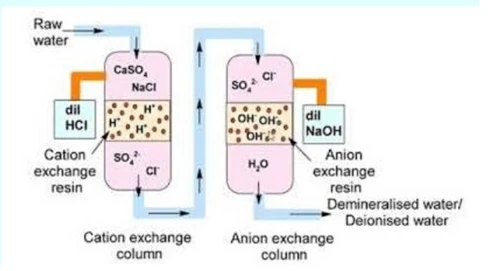
Demineralization Processes:
Types of Deionization or Demineralization Processes involves 2 steps:
1. Two-Bed Demineralization:
As the name implies, this procedure uses two vessels, one containing cation resin and the other containing anion resin. A cation exchanger is the first thing water goes through. Equivalent hydrogen ions are exchanged for each cation. This maintains the electrical equilibrium of the water. An anion exchange is then performed on the water leaving the cation. Here, anions are swapped for hydroxyl ions according to the same principle.
2. Mixed-Bed Demineralization:
The cation and anion resins are combined in a single pressure vessel in place of two separate vessels. This method is unquestionably thought to be more effective than the two-bed plants, but the regeneration process required is trickier in this case. Compared to two-bed plants, mixed-bed plants produce water of greater quality. They are typically utilized, nevertheless, when a higher level of filtration is necessary. Water is further refined using the mixed-bed process after the two-bed demineralization procedure.
A wastewater treatment method called demineralization cleanses water to a degree comparable to that of distilled water. It is a quick procedure that doesn't need scale to accumulate. The demineralization process adheres to a number of principles, including polishing, degasification, and ion exchange.
The ion-exchange method of water filtration is rapid and reversible. And the technology of demineralization is one of the tried-and-true methods for treating water. Depending on the makeup of the water that needs to be treated, different components may be used in different processes.
The technique of demineralizing water is widely used in the domains of textiles, chemicals, boiler feed water, hospitals, swimming pools, the pharmaceutical industry, and the automotive industry.
- Reverse Osmosis (RO): Pressurized filtration through a semi-permeable membrane removes many ionic and non-ionic contaminants before DI treatment.

- Electrodeionization (EDI): Combines ion-exchange with electrical regeneration-no chemical regeneration needed, providing continuous high-purity water.


