


Hey there! As a supplier of radial gates, I've seen firsthand how crucial sensors are in making these gates work smoothly and safely. Radial gates, also known as Tainter Gate, are widely used in dams and water control systems. They're designed to regulate water flow, and sensors play a key role in ensuring they do their job effectively.
Let's start by talking about level sensors. These bad boys are super important because they tell us how much water is in the reservoir or channel. There are different types of level sensors, but one of the most common ones is the ultrasonic level sensor. It works by sending out ultrasonic waves that bounce off the water surface and then measuring the time it takes for the waves to return. This way, we can accurately determine the water level.
Another type of level sensor is the pressure sensor. It measures the pressure exerted by the water column above it. The deeper the water, the higher the pressure. By converting this pressure into a water level reading, we can keep tabs on how much water is present. Level sensors are essential for radial gates because they help us decide when to open or close the gates to maintain the right water level.
Next up are position sensors. These sensors are used to figure out the exact position of the radial gate. You see, radial gates move in an arc, and it's crucial to know where they are at any given time. One popular type of position sensor is the potentiometer. It's a simple device that changes its electrical resistance based on the position of the gate. As the gate moves, the potentiometer's resistance changes, and this change is converted into a position reading.
There are also encoder-based position sensors. These sensors use a rotating disk with patterns on it. As the gate moves, the encoder reads these patterns and calculates the position. Position sensors are vital for radial gates because they ensure that the gates open and close to the correct position, preventing any over - or under - movement.
Load sensors are another key component. Radial gates have to withstand a lot of force from the water. Load sensors are used to measure this force. Strain gauge load sensors are commonly used. They work by measuring the strain or deformation in a material when a load is applied. When the water exerts pressure on the gate, the strain gauge detects the change in the gate's structure and converts it into a load reading.
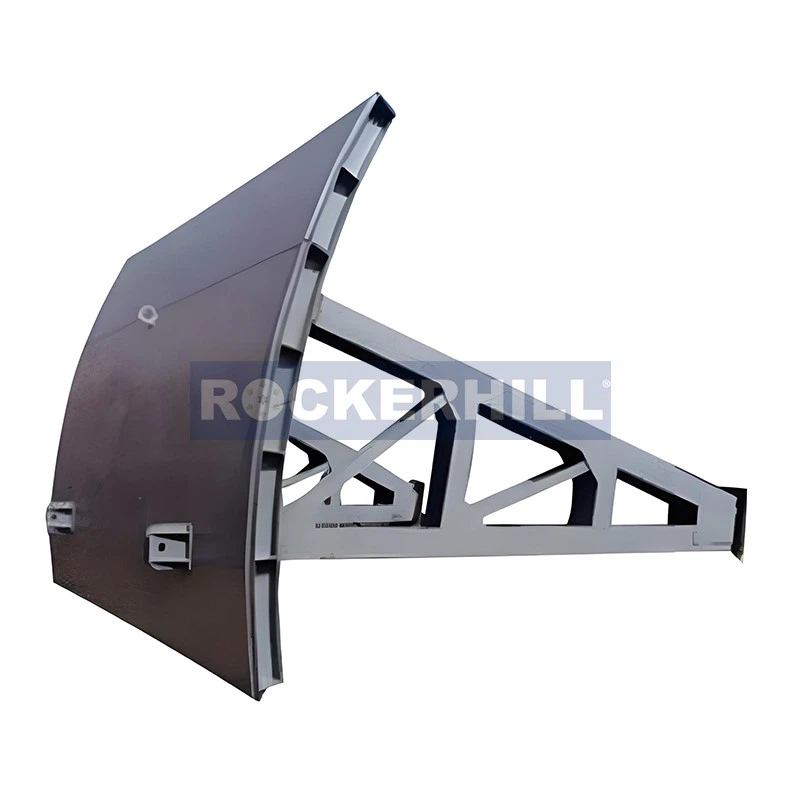

By monitoring the load on the gate, we can make sure that the gate isn't overloaded. If the load gets too high, we can take appropriate action, like adjusting the gate position or performing maintenance. This helps prevent any damage to the gate and ensures its long - term reliability.
Flow sensors are also used in radial gate systems. These sensors measure the rate of water flow through the gate. One type of flow sensor is the electromagnetic flow sensor. It works based on Faraday's law of electromagnetic induction. When water flows through a magnetic field created by the sensor, an electrical signal is generated. The strength of this signal is proportional to the flow rate of the water.
There are also ultrasonic flow sensors. They use ultrasonic waves to measure the flow velocity of the water. By knowing the flow rate, we can better control the radial gates. For example, if we want to release a certain amount of water, the flow sensor data helps us adjust the gate opening accordingly.
Temperature sensors are often overlooked but are still important. Radial gates are made of metal, and temperature changes can affect their performance. Temperature sensors are used to monitor the temperature of the gate components. Thermocouples are commonly used temperature sensors. They work by generating a voltage based on the temperature difference between two different metals.
If the temperature gets too high or too low, it can cause the metal to expand or contract, which might affect the gate's operation. By monitoring the temperature, we can take steps to protect the gate, like applying insulation or adjusting the operating conditions.
Vibration sensors are also used in radial gate systems. Radial gates can experience vibrations due to water flow, wind, or other external factors. Vibration sensors are used to detect these vibrations. Accelerometers are a common type of vibration sensor. They measure the acceleration of the gate's movement caused by vibrations.
Excessive vibrations can cause fatigue and damage to the gate over time. By using vibration sensors, we can detect any abnormal vibrations early on and take corrective action, such as adjusting the gate's position or adding damping devices.
Now, let's talk about how these sensors work together. All these sensors are connected to a control system. The control system collects data from all the sensors and uses it to make decisions about the operation of the radial gate. For example, if the level sensor shows that the water level is rising too fast, the control system can use the position sensor to open the gate wider.
At the same time, the load sensor data is used to ensure that the gate can handle the increased water pressure. The flow sensor data helps in fine - tuning the gate opening to achieve the desired water flow rate. This integrated system of sensors and control ensures that the radial gate operates efficiently and safely.
As a radial gate supplier, I've seen how these sensors have revolutionized the way we manage water systems. They provide real - time data that allows us to make informed decisions and keep the water infrastructure running smoothly. Whether it's a Dam Radial Gate in a large - scale dam project or a smaller radial gate in a local water control system, sensors are the unsung heroes.
If you're in the market for radial gates or need to upgrade your existing gate system, the right sensors can make all the difference. They not only improve the performance of the gates but also enhance the safety and reliability of the entire water control system.
So, if you're interested in learning more about our radial gates and the sensor systems we offer, don't hesitate to reach out for a procurement discussion. We're here to help you find the best solution for your water control needs.
References:
- Textbooks on hydromechanical engineering
- Industry reports on radial gate technology
- Manufacturer's specifications for sensors used in radial gate systems




