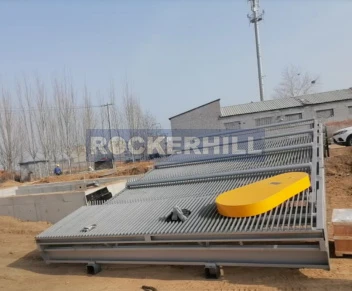
A penstock gate or sluice gate is a movable leaf that opens, throttles or shuts off flow in a channel, pipe or tank. A radial gate does the same job on wide openings, using a curved face that swings on a pivot. The right gate depends on opening width, water head, how often it moves and who will maintain it. A good sluice gate manufacturer will size all three types against your channel drawing.
Penstock gate vs sluice gate
In practice the two names describe the same family: a flat leaf that slides in a guide frame, usually raised and lowered by a stem and a handwheel or electric actuator. "Penstock" is the term many water and wastewater buyers use for gates mounted on a wall or channel. "Sluice gate" is the broader name used for intakes, canals and dams. Confirm the term in your tender, because the name does not change the engineering.
Typical uses include isolating a channel for screen maintenance, diverting flow between tanks, and controlling levels in canals.
Radial gate
A radial gate acts like a section of a drum. Water pressure on the curved face passes through horizontal beams to radial arms, which carry the thrust to a pivot, and flow passes under the face as the gate opens. One manufacturer describes it as a lightweight, economical gate that can be operated with minimum effort (Hydro Gate). Typical applications are irrigation diversion, the top of dams to raise reservoir level, and spillways or drainage canals that must hold a water level.
Seals matter. The same source specifies neoprene side and bottom seals, and warns that a floor out of level by more than 1/8 inch will leak. Specify the sill and floor tolerance in the civil design.
How to choose
- Narrow channel, isolation duty: penstock or sluice gate.
- Wide opening, regular level control: radial gate.
- Intake with screens: add stop logs or a sluice gate upstream, so one screen can be dewatered while others keep working.
- Outfall with backflow risk: add a flap gate.
Comparison
|
Penstock gate |
Sluice gate |
Radial gate |
|
|
Motion |
Slides up and down in a frame |
Slides up and down in a frame |
Swings on a pivot |
|
Best for |
Wall or channel isolation |
Intakes, canals, dams |
Wide openings, level control |
|
Flow control |
On/off or throttling |
On/off or throttling |
Level and flow control |
|
Main check |
Seating head and seal |
Frame and guide wear |
Sill level and pivot support |
What to ask a sluice gate manufacturer
- Materials: SS304, SS316L or coated carbon steel, depending on water quality and design life.
- Seals: type, expected leakage and replacement access.
- Operation: handwheel, electric actuator or hydraulic, with limit switches and position feedback if needed.
- Range and references: Rockerhill lists sluice, radial, hydro, flap and stop log gates, together with water intake screens (Rockerhill).
Data needed for a quotation
- Gate type, or the duty: isolation, flow control or level control
- Opening width and height, and design water head on each side
- Seating direction: water pressure from one side or both
- Material and actuator type
- Channel or wall drawing, and installation elevation
FAQ
Is a penstock gate the same as a sluice gate? Mostly. Both are sliding-leaf gates, and the name varies by region and industry. Check the drawing, not the label.
When is a radial gate better than a sluice gate? For wide openings where level control matters, because the curved face is lightweight and opens with relatively little effort.
Can the supplier provide gates and screens together? Yes. Rockerhill supplies gates and water intake screens, so the interface can be designed once.
Get a quote
Send your opening size, water head and channel drawing to Allie.s@rockerhillcn.com, and Rockerhill will propose a penstock gate, sluice gate or radial gate package.
Sources: Hydro Gate radial gate brochure for radial gate design and seals; Rockerhill for the product range. The penstock and sluice gate naming, the comparison table and the selection guidance are general industry practice.