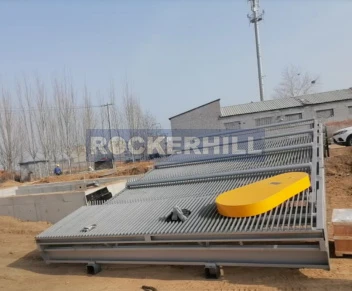
A rotary drum screen (also called a rotating drum screen or drum screen) is a rotating cylindrical screen that separates solids from flowing water. Water passes through the perforated plate or wedge-wire drum surface, while solids stay on the screen and are carried out for discharge. It is widely used for fine screening in municipal wastewater headworks, membrane bioreactor (MBR) protection and industrial wastewater treatment.
How a rotary drum screen works
- Influent enters a headbox, which calms the flow and spreads it evenly across the inner wall of the drum.
- Water passes outward through the perforations or wedge-wire openings. Splash guards direct the filtrate to a central drainage area.
- Solids stay on the screen surface. As the drum rotates, internal flights carry them to the open end of the drum for discharge.
- A fixed spray bar washes the screen intermittently, which keeps the openings clear.
Internally fed and externally fed drum screens
An internally fed rotary drum screen takes water inside the drum. Water flows outward, and solids are held on the inner surface. This is the common layout for wastewater headworks. An externally fed drum screen reverses the flow: water passes from the outside in, and solids are removed from the outer surface by a scraper or brush.
Key parts are the drum (perforated plate or wedge wire), headbox, drive, spray bar, frame and solids discharge.
Applications
- Fine screening at municipal wastewater headworks with high flow and low solids content
- Protecting MBR membranes from fibers and other fine particles
- Screening scum from clarifiers
- Industrial wastewater and water intake pretreatment
The opening size is selected for each application, in perforated plate or wedge wire.
Rotary drum screen vs bar screen vs band screen
|
Rotary drum screen |
Bar screen |
Traveling band screen |
|
|
Screening surface |
Perforated plate or wedge-wire drum |
Parallel bars |
Moving mesh panels |
|
Opening |
Fine |
Coarse |
Medium to fine |
|
Cleaning |
Rotation and spray bar |
Rake |
Panel lift and spray wash |
|
Typical role |
Fine screening stage |
First coarse stage |
Deep intake channels |
How to choose a rotary drum screen
Send these data to the manufacturer, and the feed type, drum size and opening can be proposed together:
- Peak and average flow rate (m³/h)
- Water type and solids load: fibers, hair, plastics, scum
- Required opening size (mm)
- Channel or tank dimensions, and internally or externally fed layout
- Material: SS304 or SS316L
FAQ
What does a rotary drum screen remove? Fibers, hair, plastics, fine solids and scum. This protects pumps, membranes and downstream equipment.
Does a rotary drum screen replace a bar screen? Not usually. A bar screen takes coarse debris first, and the rotary drum screen handles the fine screening stage.
Which material is used? Stainless steel is standard. One vendor builds the whole unit in 304 stainless steel, and SS316L is the usual choice for corrosive or seawater duty.
Get a quote
Rockerhill design and manufacture rotary drum screens, bar screens, band screens and fine screens for water and wastewater projects. Send your flow rate, solids data and opening size to Allie.s@rockerhillcn.com.