A CRN (Canadian Registration Number) is the number a provincial or territorial safety authority assigns to a pressure vessel, pressure piping system or pressure fitting design after reviewing it against CSA B51 and the referenced ASME codes. A process skid that contains pressure equipment cannot legally be installed and operated in most of Canada until each regulated component and, in many provinces, the piping design has a CRN for that province.
For buyers sourcing a custom process skid from outside Canada, CRN is the step that most often delays a project. This guide explains what needs a CRN, who issues it, and how a skid manufacturer should plan for it from the first P&ID. It is based on ROCKERHILL's experience designing and building an ASME-coded CO2 carbon capture skid for a Canadian project, registered through ABSA, as well as a hydrogen peroxide (H2O2) production skid built to US standards for a client in the United States.

What is a CRN?
The CRN is a design registration, not a product certification. The safety authority checks that the design (drawings, calculations, materials and code basis) meets the code, then assigns a number. That number must be stamped or tagged on the equipment and shown in its documentation.
Key points:
- It is issued province by province. A CRN registered in Alberta is valid in Alberta. To install the same design in Ontario, it must also be registered there. The digit after the decimal point in a CRN shows the provinces where it is registered.
- It is based on CSA B51. CSA B51, Boiler, Pressure Vessel, and Pressure Piping Code, is adopted by the provinces and in turn references ASME codes such as BPVC Section VIII (pressure vessels) and ASME B31.3 (process piping).
- It applies to the design. Every unit built to that registered design can carry the same CRN, provided it is built under an accepted quality program.
Who issues CRNs?
Each province and territory has its own pressure equipment authority. The best known include:
|
Province |
Authority |
|
Alberta |
ABSA, the pressure equipment safety authority |
|
Ontario |
TSSA (Technical Standards and Safety Authority) |
|
British Columbia |
Technical Safety BC |
|
Quebec |
RBQ (Régie du bâtiment du Québec) |
|
Saskatchewan |
TSASK (Technical Safety Authority of Saskatchewan) |
Requirements, exemptions and review times differ between authorities. Always confirm the current rules with the authority for the province where the skid will be installed.
What on a process skid needs a CRN?
A typical process skid combines several kinds of regulated pressure equipment. Each is treated differently.
|
Skid component |
Typical CRN route |
Who usually registers it |
|
Pressure vessels (scrubbers, separators, receivers, filter housings) |
Vessel design registration: drawings + calculations to ASME Section VIII |
Skid or vessel manufacturer |
|
Heat exchangers (shell and tube, some plate types) |
Registered as pressure vessels |
Exchanger manufacturer |
|
Interconnecting process piping |
Piping system design registration to ASME B31.3, where the province requires it |
Skid manufacturer |
|
Fittings (valves, strainers, flexible hoses, instruments, relief valves) |
Fitting registration, usually by statutory declaration and quality program |
Fitting manufacturer |
|
Compressors and pumps |
Pressure-containing casings may need registration depending on the province and design conditions |
Equipment supplier |
Small vessels and low-pressure equipment below certain size and pressure thresholds may be exempt. The thresholds vary by province, so the exemption must be checked for every item, not assumed.
How the CRN process works for an imported skid
- Confirm the jurisdiction early. The province of installation decides which authority reviews the design. If the skid may later move to another province, register in both from the start.
- Build the code basis into the design. Vessels are designed to ASME Section VIII, piping to ASME B31.3, and welding procedures and welders are qualified to ASME Section IX. Materials must be code-listed with traceable mill certificates.
- Choose fittings that already carry a CRN. Selecting valves, instruments and hoses that are already registered in the target province removes the most common cause of delay. Unregistered fittings mean extra paperwork or a late substitution.
- Prepare the submission. This normally includes general arrangement and detail drawings, design calculations, material specifications, the welding procedure list and the manufacturer's quality program.
- Answer reviewer comments. The authority may request revised calculations or clarifications. A manufacturer who has been through the process before answers faster.
- Fabricate and inspect under the accepted quality program. Fabrication, NDE and pressure testing must follow the registered design and the code. Many projects add third-party inspection.
- Tag and document. Each registered item is nameplated with its CRN. The manufacturer's data report and test records go into the final documentation package.
Don't forget electrical approval
CRN covers pressure equipment only. Electrical equipment on a skid shipped to Canada must also meet the Canadian Electrical Code (CSA C22.1). In practice, that means using components and control panels with cUL or CSA certification marks, or arranging a field evaluation before energization. On ROCKERHILL's Canadian carbon capture skid, all electrical components were specified as cUL/CSA certified from the start.
Common CRN mistakes, and how to avoid them
- Leaving CRN until after fabrication. Registration should run in parallel with detailed design, not after the skid is built.
- Assuming an ASME U-stamp is enough. ASME code compliance is required, but it does not replace provincial registration.
- Ignoring fittings. One unregistered valve or flexible hose can hold up commissioning.
- Registering in the wrong province. The CRN must match the province of installation.
- Incomplete material traceability. Missing mill certificates are a frequent reason for reviewer comments.
Case example: ASME-coded CO2 capture skid for Canada
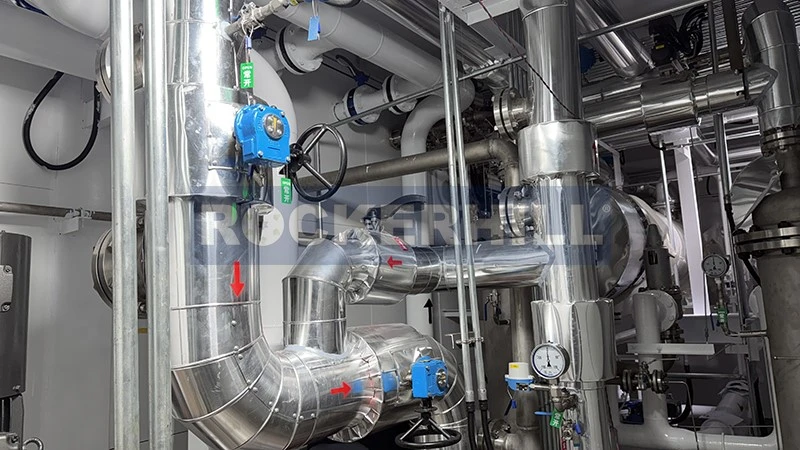
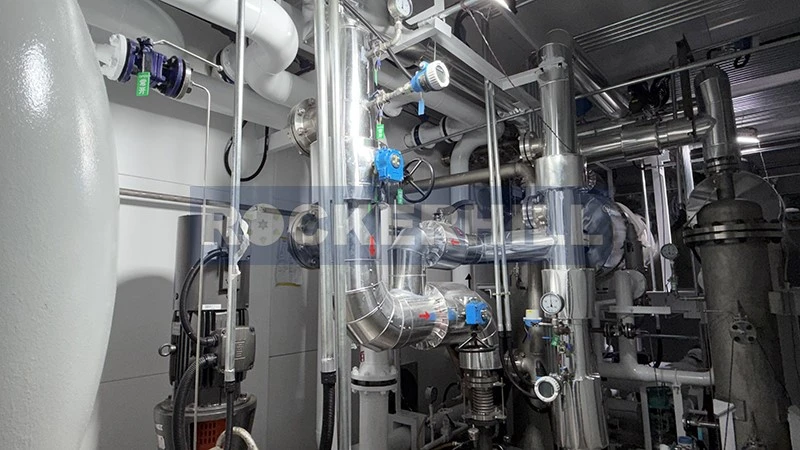
In 2026, ROCKERHILL won an international competitive tender to supply a balance-of-plant skid for a CO2 direct air capture (DAC) project in Canada. The scope covered 27 supply line items, including custom heat exchangers, ASME-coded vacuum scrubbers, a dry screw compressor, a vacuum pump, a local control panel, a transformer, detailed engineering and full skid assembly.
The project specified:
- ASME Pressure Vessel Code for vessels
- CSA B51 for boilers, pressure vessels and pressure piping
- CRN registration through ABSA for all pressure vessels and piping
- cUL/CSA certification for all electrical components
- Container heating, ventilation and insulation for extreme Canadian winter temperatures
ROCKERHILL has CRN registration process skid reference in Canada, and also designed and built a low-concentration H2O2 production skid for a client in the USA, engineered to US standards with 120 V / 60 Hz power, a NEMA 4X control panel and full FAT/SAT documentation.
Why the manufacturer matters
CRN success depends far more on how the skid is engineered than on the paperwork at the end. When you evaluate a process skid manufacturer for a Canadian project, ask:
- Have you registered skid components with a Canadian authority before? Which one?
- Who prepares the CRN submission and answers reviewer comments?
- Will all fittings be selected with existing CRNs for my province?
- Are your welding procedures and welders qualified to ASME Section IX?
- Can your control panels be supplied cUL/CSA certified?
- Can I witness the factory acceptance test (FAT) in person or by video?
ROCKERHILL is a designer and manufacturer of custom process skids, with operating references including an ASME-coded CO2 carbon capture skid for Canada and an H2O2 production skid for the USA. Every skid is factory tested before shipment, and comes with commissioning support, training, a spare parts list and an 18-month warranty.
Frequently asked questions
Does every process skid need a CRN in Canada? No. A skid needs CRNs for the regulated pressure equipment it contains, such as vessels, piping and fittings above the provincial exemption thresholds. A skid with no regulated pressure equipment may not need one, but this must be confirmed for the province.
Is the CRN for the whole skid or for each component? Usually for each component and, in many provinces, for the piping system. There is normally not a single CRN for an entire skid.
Can a manufacturer outside Canada obtain a CRN? Yes. Foreign manufacturers routinely register designs with Canadian authorities, provided the design meets the code and the manufacturer operates an accepted quality program.
How long does CRN registration take? It depends on the authority, the complexity of the design and the quality of the submission. Plan for it as part of the detailed design schedule rather than as a final step. [Add ROCKERHILL's typical experience, if available.]
Is a CRN valid in every province? No. A CRN is valid only in the provinces where the design is registered. The same design can be registered in more than one province.
What is the difference between a CRN and an ASME U-stamp? The ASME U-stamp shows the vessel was built by an ASME-certified manufacturer to Section VIII. The CRN shows a Canadian provincial authority has reviewed and registered the design. A Canadian project usually needs both.
Does CRN cover the control panel? No. Electrical equipment is covered by the Canadian Electrical Code and needs cUL/CSA certification or a field evaluation.