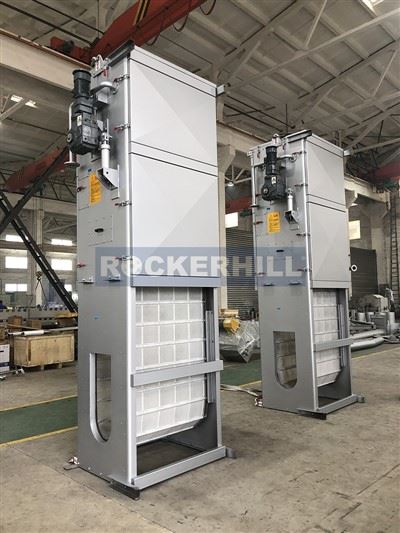
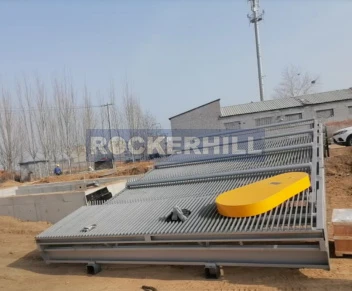
A bar screen retrofit is the replacement or upgrade of a screen in an existing channel, designed around the concrete that is already there, so the plant gains better screening without major civil works. Typical reasons are a worn-out screen, spare parts that are no longer available, more wipes and rags than the old screen can handle, or a need for a finer opening ahead of a process upgrade.
New-build screens get most of the attention in manufacturers' literature, but a large share of real projects are retrofits, and they are harder. The channel is never quite the size shown on the 30-year-old drawing, the plant must keep running, and every millimetre of extra head loss has to fit within walls that cannot move. This guide sets out how ROCKERHILL approaches a retrofit, from the site survey to the night the old screen comes out.
Step 1: Survey the channel as it really is
Old drawings are a starting point, never the basis for fabrication. Measure on site, ideally with the channel dewatered.
Site survey checklist
Channel width at several heights from floor to top of wall. Walls are often out of plumb or tapered.
Channel depth from operating floor to invert, and invert condition (level, damaged, silted).
Wall condition: spalling, exposed rebar, corrosion from H₂S, suitability for new anchors.
Water levels: normal, peak and maximum flood levels, and existing marks on the walls.
Headroom above the operating floor: roof, beams, lifting equipment, building openings.
Discharge height needed to reach the existing or new conveyor, compactor or skip.
Access route for delivery and lifting: door sizes, crane positions, floor loading.
Existing embedded parts: guides, anchor plates, frames, slots for stoplogs.
Isolation: existing penstocks, stoplog slots or bypass channels, and whether they still seal.
Electrical and controls: power supply, cable routes, level instruments, SCADA interface.
Photos and video of the channel, old screen and surroundings, with a scale reference.
A 3D laser scan is useful on complex or deep channels, but a careful tape and laser survey with photographs is enough for most screens.
Step 2: Recheck the hydraulics before choosing the opening
The most common retrofit mistake is to fit a finer screen into the same channel without checking the head loss. A narrower bar spacing reduces the open area, raises the through-bar velocity and increases head loss, especially when the rack is partly blinded.
Before fixing the new opening:
Calculate the head loss of the new screen at peak flow, clean and partly blinded (Contact us for bar screen head loss calculation guide).
Check that the higher upstream level stays below the top of the channel walls with freeboard.
Check that it does not surcharge the incoming sewer or flood upstream structures.
Check that the bypass or emergency overflow still operates at the right level.
If the head loss is too high, options include profiled bars with lower head loss, a slightly wider spacing in the first stage with a fine screen downstream, or two screens in parallel channels.
Step 3: Choose a screen type that suits the existing channel
Different screen types suit different retrofit constraints.
|
Constraint |
Multi-rake bar screen |
Climber (single-rake) screen |
Catenary screen |
Band screen |
|
Deep channel |
Very good; units over 7 m deep are routine |
Good, but the rake travel gets long |
Limited by chain geometry |
Good |
|
Wide channel |
Very good; built in modules for wide racks |
Moderate |
Good |
Good |
|
High debris load |
Very good; several rakes clean in sequence |
Moderate; one rake per cycle |
Good |
Depends on opening |
|
Limited headroom |
Good; compact head frame |
Poor; the rake mechanism needs height above the floor |
Good |
Moderate |
|
No submerged moving parts wanted |
Possible with foot guides instead of submerged sprockets |
Yes |
Yes |
No |
|
Limited space in front of the rack |
Very good |
Very good |
Poor; needs space for the chain loop |
Good |
|
Fine 3D screening needed |
No (2D) |
No (2D) |
No (2D) |
Yes, with perforated plate or mesh |
For most municipal inlet works retrofits, a multi-rake bar screen is the most flexible choice because it fits narrow and wide, shallow and deep channels and handles heavy debris. Where a plant needs fine 3D screening, for example ahead of an MBR upgrade, a band screen can often be fitted into the existing channel, sometimes behind a retained coarse screen.
Step 4: Design for the imperfect channel
A retrofit screen has to absorb the channel's imperfections without leaving gaps.
Side seals and wall plates. Adjustable side seals or stainless steel wall plates close the gap between the rack and uneven walls. The remaining gap must never exceed the bar spacing.
Bottom seal. The rack foot should seal against the invert. Where the invert is damaged, a grout bed or a stainless steel sill plate gives a true surface.
Adjustable frames. Slotted anchor connections allow for walls that are out of plumb.
Anchors. Chemical anchors in sound concrete, positioned away from cracked or spalled areas. Repair concrete before installing anchors, not after.
Modular construction. Wide or tall screens can be built in bolted modules so they fit through existing doors and can be lifted by existing cranes.
Step 5: Plan how the plant keeps running
The plant cannot stop while the screen is changed. Plan the flow management with the operator.
|
Option |
How it works |
Considerations |
|
Duty and standby channels |
Isolate one channel while the other carries the flow |
Simplest; check the remaining screen can carry the flow during the works |
|
Bypass channel with manual rack |
Divert flow through the bypass while the screen is replaced |
Requires frequent hand raking; plan staffing |
|
Temporary screen |
A temporary bar rack or basket screen in the channel or upstream chamber |
Useful where there is only one channel |
|
Over-pumping |
Pump the flow around the works |
Most expensive; used where no other option exists |
|
Timing |
Work in dry weather and at low-flow hours |
Check the weather forecast and have a storm plan |
Good isolation equipment makes this much easier. Penstocks and stoplogs that actually seal are often replaced at the same time as the screen.
Step 6: Prefabricate and test, then install fast
The less work done in the channel, the shorter the outage and the lower the risk.
Factory assembly and testing. The new screen should be fully assembled and run in the factory, so that problems are found before it arrives on site.
Trial fit of critical dimensions. Check the as-built screen against the survey dimensions before shipment.
Installation sequence. Remove the old screen, repair concrete, set wall plates and anchors, lift in the new screen, align, seal, connect power and controls.
Commissioning. Run the screen dry and wet, check rake engagement, wiper adjustment, overload protection, level control set points and SCADA signals.
Handover. Training for operators and maintenance staff, O&M manual, spare parts list and updated drawings.
Retrofit project information checklist
Send these to your screen supplier for a retrofit proposal
Design and peak flows, now and in the future
Site survey dimensions and photographs (Step 1)
Existing screen data: type, manufacturer, bar spacing, problems experienced
Required bar spacing or opening, and the downstream equipment it protects
Maximum allowable head loss and channel wall levels
Material preference and water chemistry (H₂S, chlorides)
Power supply and control interface
Constraints on access, lifting and outage duration
ROCKERHILL retrofit capability
ROCKERHILL designs every screen to fit the channel, which is exactly what a retrofit needs. Our multi-rake bar screens have been built for channels up to 4,800 mm wide and about 7.3 m deep, with bar spacing from 3 to 50 mm and materials in AISI 304, 316L and duplex 2205. Wide racks can be built in modules that bolt together on site, and every screen is fully assembled and tested in our factory before shipment. Because ROCKERHILL also manufactures penstocks, slide gates and stoplogs, we can supply the isolation equipment that a retrofit often needs as part of the same package. Remote commissioning support is standard, and site supervision is available on request.
Design, engineering and in-house manufacturing
Retrofits depend on custom engineering: no two existing channels are the same. ROCKERHILL's in-house design and fabrication let us build each replacement screen to the measured channel instead of adapting a standard unit.
|
Capability |
What it means for your project |
|
In-house design and engineering |
Our own engineers size the rack, chains, rakes, panels and frame by calculation from your flow, channel geometry, discharge height and water chemistry. We check the hydraulics before we propose a screen. |
|
Customisation |
Every screen is built to the channel: widths up to 4,800 mm and depths of about 7.3 m delivered, bar spacing from 3 to 50 mm, a choice of bar profiles and mesh or perforated plate panels, AISI 304, 316L, duplex 2205 or coated carbon steel, and drives for the local power supply. |
|
Project documentation |
General arrangement drawings, vendor data sheets, structural calculations, ITPs, O&M manuals and spare parts lists, in the client's format and revision system, issued for approval before fabrication. |
|
Codes and standards |
Design to ASTM, ASME, EN and GB codes or to the project specification; welding to ASME Section IX procedures; EN 10204 3.1 material certificates. |
|
In-house manufacturing |
Cutting, welding, machining, and pickling and passivation of stainless steel in our own workshops in China, under our own quality control, with visual and penetrant inspection of welds. |
|
Factory testing |
Every screen is fully assembled and function-tested before shipment, witnessed by the client or recorded on photo and video. Third-party inspection is accepted. |
|
Delivery and support |
Export packing on flat racks or in bolted modules for wide units, installation drawings, remote commissioning support and site supervision on request. |
|
One supplier for the package |
Screens, screenings handling equipment, and the penstocks, sluice gates, stoplogs and radial gates that isolate screen channels, from one engineering team. |
One team owns each project, from the first sizing calculation to the last commissioning check.
Global project references
ROCKERHILL has delivered custom screens and gates for new and existing structures in many countries. ROCKERHILL has project references in 30 countries, and our bar screens and related screening equipment are in service across the United States, Canada, Australia and Singapore, as well as Mexico, Croatia, the Middle East and China.
Frequently asked questions
Can a new bar screen be installed in an existing channel? Yes. A retrofit screen is designed to the measured dimensions of the existing channel, with adjustable side seals, wall plates and anchors to suit uneven walls, so major civil works are usually not needed.
What information is needed to replace a bar screen? Accurate channel dimensions from a site survey, flows, water levels, headroom, discharge height, required bar spacing, material, power supply and photos of the existing installation.
Can I change to a finer bar spacing when I replace a screen? Often, yes, but first check the head loss of the finer screen at peak flow. A finer spacing increases head loss, which must fit within the existing channel walls and must not surcharge the incoming sewer.
Which screen type is best for a retrofit? A multi-rake bar screen is the most flexible for most municipal channels. A climber screen suits shallow channels where no submerged moving parts are wanted and headroom is available. A band screen suits retrofits that need fine 3D screening.
How do you keep the plant running while the screen is replaced? By using a standby channel, a bypass channel with a manual rack, a temporary screen or over-pumping, and by working at low flow in dry weather.
How long does it take to install a replacement bar screen? Installation time depends on the screen size, concrete repairs and access. Factory assembly and testing, accurate survey data and modular construction keep the outage as short as possible. [Add ROCKERHILL's typical installation duration for a standard screen.]
Can you replace a screen made by another manufacturer? Yes. ROCKERHILL designs replacement screens to fit existing channels regardless of the original manufacturer.
Where has ROCKERHILL supplied screens? ROCKERHILL bar screens and related screening equipment are in service in the United States, Canada, Australia and Singapore, as well as Mexico, Croatia, the Middle East and China, among project references in 30 countries.
Does ROCKERHILL design and manufacture its screens in house? Yes. Our own engineers design every screen, it is fabricated in our own workshops in China, and it is fully assembled and tested in the factory before shipment.
Planning to replace an old or underperforming screen? Send ROCKERHILL your channel survey, photographs and flow data, and our engineers will propose a screen that fits the channel you already have. Contact Allie at Allie.s@rockerhillcn.com.
Author: [Allie Shen], ROCKERHILL. Last updated: [Nov 17,2026].