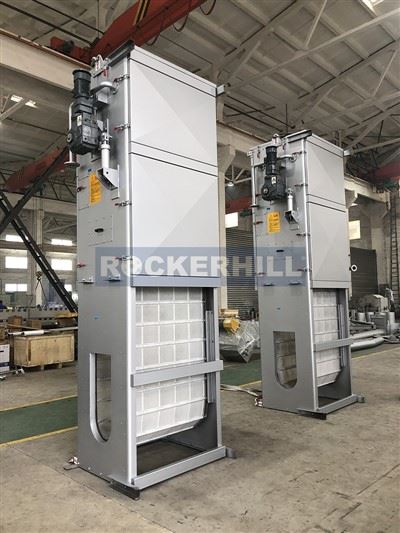
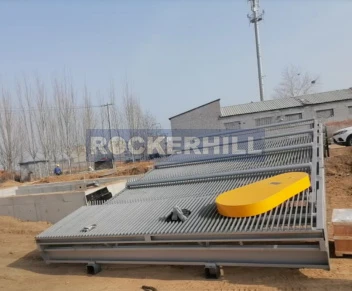
The bar screen is the first piece of mechanical equipment wastewater meets when it enters a treatment plant. If it is undersized, blinds too easily or breaks down, everything downstream suffers: pumps rag up, grit chambers fill with plastics and operators spend their shifts clearing blockages by hand.
ROCKERHILL designs and manufactures bar screens for municipal and industrial headworks, pumping stations and raw water and seawater intakes. Our screens are in operation in the United States, Canada, Australia and Singapore, among 30 countries. This guide walks through the decisions we go through with every client, in the order we make them, and shows what a complete specification and vendor data sheet look like.
Step 1: Define the duty
Start with what the screen must protect and what it will see.
- Design flow and peak flow. Peak wet-weather flow sets the channel velocity and head loss, and therefore the screen size.
- Upstream conditions. Combined sewers carry far more rags, wipes and grit after storms than separate sanitary sewers.
- Downstream equipment. Membrane bioreactors (MBR) need fine screening. A pumping station may only need coarse protection.
- Water type. Municipal wastewater, industrial effluent, raw river water and seawater all point to different materials.
Step 2: Choose the bar spacing
Bar spacing (the clear opening between bars) is the single most important number on the datasheet.
|
Application |
Typical bar spacing |
|
Pumping stations, raw water and seawater intakes |
25 to 50 mm |
|
Municipal inlet works, coarse screening |
10 to 25 mm (15 mm typical for municipal fine screening) |
|
Fine screening, MBR pre-treatment |
3 to 10 mm |
Narrower spacing captures more screenings but increases head loss and cleaning frequency. Many plants use two stages: a coarse bar screen at 20 to 25 mm followed by a fine screen at 3 to 6 mm. ROCKERHILL multi-rake bar screens are available from 3 to 50 mm spacing, and we size the spacing from your flow and downstream equipment rather than from a catalogue.
Step 3: Choose the screen type
|
Type |
How it works |
Best for |
|
Multi-rake (chain-driven) |
Several rakes on endless chains clean a fixed bar rack in sequence |
Large plants (typically ≥ 10,000 m³/day), wide or deep channels, heavy debris loads |
|
Single-rake / climber |
One rake travels up and down the rack |
Moderate flows, shallow channels, retrofits with no submerged moving parts |
|
Step screen |
Moves screenings up in steps |
Medium plants with a high rag content |
|
Band screen |
A continuous moving belt of mesh panels |
Fine screening at intakes and before MBR |
|
Manual bar rack |
Raked by hand |
Small plants (≤ 5,000 m³/day) or bypass channels |
For most municipal inlet works, the multi-rake bar screen is the workhorse. Because several rakes work in sequence, the rack is cleaned more often and head loss stays lower at high flows and on wide channels. A mechanical screen is the usual choice above about 5,000 m³/day, where 24/7 automatic cleaning is needed.
Step 4: Fit the screen to the channel
A bar screen should be built to the channel, not the other way round. Confirm:
- Channel width. ROCKERHILL has delivered a multi-rake bar screen for a channel 4,800 mm wide.
- Channel depth. Up to about 7.3 m delivered.
- Discharge height above the operating floor, so screenings drop cleanly into a conveyor, washer-compactor or skip.
- Installation angle. Mechanical multi-rake screens are installed at 60° to 80°, typically 75°. Manually cleaned bar racks are flatter, at 45° to 60°.
Check the approach velocity too. Too low and grit settles in front of the screen; too high and debris is forced through the bars.
Step 5: Select the material
|
Material |
Typical use |
|
AISI 304 stainless steel |
Most municipal wastewater |
|
AISI 316L stainless steel |
High chlorides, industrial effluent, coastal plants |
|
Duplex 2205 stainless steel |
Seawater intakes and aggressive duty, often with sacrificial anodes |
|
Coated carbon / galvanized steel |
Budget option for low-flow, non-aggressive water; needs coating upkeep |
For the PPLAK project in Singapore, for example, ROCKERHILL supplied four 316L stainless steel bar screens built for a coastal, high-chloride environment.
Step 6: Specify drive, controls and safety
- Drive: geared motor, IP55 or higher, S1 duty, supplied to the local electrical standard.
- Control: timer, level difference or manual mode, with a high-speed rake mode for storm peaks and run and fault contacts for SCADA.
- Overload protection: torque limiter or shear pin plus an electronic overload trip on the geared motor.
- Guarding and access: covers for odour control, inspection doors in the head cover, and drive and chain running above water for safe maintenance.
Step 7: Plan for screenings handling and maintenance
The screen is only half the system. Allow for a screw conveyor or belt, a washer-compactor to reduce screenings volume and weight, and a skip or bagging unit. Ask the manufacturer for the maintenance schedule, the list of wear parts and their expected life, and whether spare chains and rakes are kept in stock.
Common design challenges and how we engineer around them
|
Challenge |
Cause |
ROCKERHILL design solution |
|
Stringy debris clogging |
Rags, hair and fibres wrap around bars and reduce flow |
Toothed rakes matched to the bar spacing, frequent multi-rake cleaning and a cleaning comb at the head |
|
Corrosion from biogenic acids |
Sulphate-reducing bacteria produce hydrogen sulphide (H₂S), which attacks metal |
316L or duplex 2205 stainless steel, pickling and passivation, coating to ISO 12944 where specified |
|
High flow variability |
Storm surges and morning and evening peaks raise debris loads |
Level-difference control with high-speed rake mode, generous rack sizing and bypass channel provision |
|
Wide or deep channels |
Large intakes and inlet wells need long racks and high lifts |
Rack, chain and frame designed by calculation; units delivered up to 4,800 mm wide and 7.3 m deep |
Datasheet: ROCKERHILL multi-rake bar screen
Values are typical and are fitted to each project from flow, channel dimensions and screenings load.
|
Parameter |
ROCKERHILL multi-rake bar screen |
|
Channel width |
Customised; up to 4,800 mm delivered |
|
Channel depth |
Customised; up to about 7.3 m delivered |
|
Bar spacing |
3 to 50 mm (15 mm typical for municipal fine screening) |
|
Installation angle |
60° to 80° (75° typical) |
|
Bar and frame material |
AISI 304, AISI 316L, duplex 2205, or coated carbon steel |
|
Drive |
Geared motor, IP55 or higher, S1 duty, to the local supply (e.g. 380 V / 50 Hz or 400 V / 50 Hz) |
|
Control |
Manual / auto, timer, level difference; run and fault contacts |
|
Discharge |
Chute to screw conveyor, compactor or container |
|
Wear parts |
Polymer guides and bushings on the chain and foot assembly; sealed bearings above the water line |
|
Quality documents |
EN 10204 3.1 material certificates; welding to ASME Section IX procedures; visual and penetrant weld inspection |
|
Testing |
Full factory assembly and function test (FAT), witnessed or recorded on photo and video; SAT support |
Engineered to your specification: a seawater intake data sheet
We prepare a full vendor data sheet for every order, in the client's document format and revision system. The extract below comes from a data sheet issued for approval for two raked bar screens on an industrial seawater intake. It shows the level of detail engineers can expect from ROCKERHILL.
|
Item |
Value |
|
Quantity and type |
2 sets, chain-driven raked bar screen |
|
Design flow |
1,500 m³/h normal; 3,000 m³/h peak |
|
Fluid |
Seawater, 1,025 kg/m³, 18–35 °C |
|
Bar spacing |
30 mm |
|
Head loss |
≤ 0.25 m (clean and dirty) |
|
Rake speed |
0.5–0.8 m/min normal; 0.8–1.0 m/min high |
|
Dimensions (W × D × H) |
3,000 × 1,600 × 9,300 mm |
|
Bars, guides, rakes |
Duplex stainless steel 2205 |
|
Corrosion protection |
Sacrificial zinc anodes; ISO 12944 C5-M |
|
Design life |
20 years |
|
Drive |
Chain and sprocket, SEW gear reducer |
|
Motor |
1.5 kW, 400 V 3-ph 50 Hz, IP55, Class F, PT100 winding sensor |
|
Safety device |
Torque limiter / shear pin; upper and lower limit switches |
|
Level instruments |
Radar, inlet and outlet, 4–20 mA, 0–10 m; calculated differential level output |
|
Local control panel |
Relay logic, IP55, stainless steel |
|
Standards |
ASME Section IX welding; EN 10204 3.1 certificates; IEC; ISA |
|
Tests |
FAT: mechanical run, raking, alarm and interlock, load simulation; SAT |
Design and manufacturing at ROCKERHILL
Every ROCKERHILL bar screen is designed by our own engineers and fully assembled and tested in the factory before shipment. One team owns the project from the first sizing calculation to the last commissioning check:
- Design. Rack, chain, rake and frame are sized by calculation from flow, channel geometry, discharge height and water chemistry.
- Document. General arrangement drawings, vendor data sheets and ITPs in the client's format, issued for approval and revised to comments.
- Manufacture. Cutting, welding to ASME Section IX procedures, machining, and pickling and passivation of stainless steel parts.
- Deliver. Full factory assembly and function test, flat-rack or modular export packing for wide units, installation drawings and remote commissioning support, with site supervision on request.
Project-specific standards and third-party inspection are accepted on request.
Frequently asked questions
What is a multi-rake bar screen? An automatic bar screen in which a fixed rack is cleaned continuously by several rakes on endless chains. It removes rags, plastics and debris from wastewater or raw water and discharges them to a conveyor or container.
What bar spacing should I choose for a wastewater treatment plant? Municipal inlet works usually use 10 to 25 mm. Fine screening uses 3 to 10 mm, and pumping stations or intakes may use 25 to 50 mm.
At what angle should a bar screen be installed? Mechanical multi-rake bar screens are installed at 60° to 80°, typically 75°. Manually cleaned bar racks are installed at 45° to 60°.
Which material is best for a bar screen? AISI 304 suits most municipal wastewater, 316L suits high-chloride or industrial duty, and duplex 2205 suits seawater intakes.
How do you protect a bar screen in seawater? We use duplex 2205 or 316L stainless steel, sacrificial zinc anodes and coating systems to ISO 12944 C5-M, for a design life of 20 years.
Can a wide screen be shipped overseas? Yes. We ship wide racks on flat racks or build them in modules that bolt together on site.
What do you need for a quotation? Design and peak flow, channel width and depth, discharge height, installation angle, bar spacing, material, power supply and the project drawing.