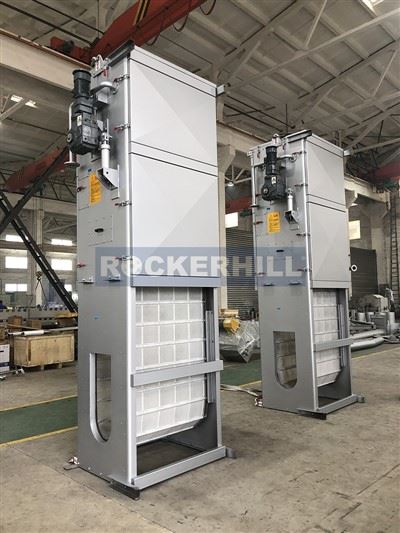
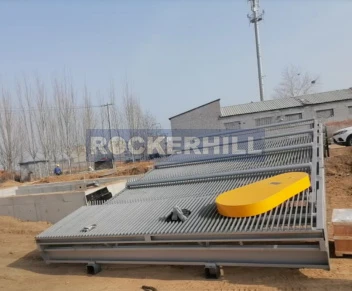
If you have ever compared tender documents from the UK, the USA and Southeast Asia, you have probably seen the same piece of equipment called three different names. A consultant in London specifies a penstock, an engineer in Texas asks for a slide gate, and a water authority in Singapore writes sluice gate. Are they the same thing?
Mostly, yes. But the differences in wording reflect real differences in standards, design habits and expectations, and getting them wrong can cost you a re-submittal. As a designer and manufacturer of water control gates with operating projects in the United States, Canada, Australia and Singapore, ROCKERHILL works with all three vocabularies every week. This guide explains what each term means, what goes into a good specification and datasheet, and how we engineer the gate behind it.
The short answer
|
Term |
Where it is used |
What it usually means |
|
Penstock |
UK, Ireland, Middle East, Singapore, Malaysia, Hong Kong, Australia (in part) |
A vertically sliding gate mounted on a wall or in a channel, used to isolate or control flow in water and wastewater works |
|
Slide gate |
USA, Canada |
The same type of gate. North American specifications usually reference AWWA C560 (cast iron) or AWWA C561 (fabricated stainless steel) |
|
Sluice gate |
Used worldwide, especially in irrigation, flood control and river works |
A gate that controls flow through an opening, often larger and lower-head than a treatment-plant penstock |
Watch out for one trap: in North America and in hydropower, a penstock is not a gate at all. It is the large pressure pipe that carries water from a reservoir to the turbines. If you are writing for a US or Canadian audience, use "slide gate" or "sluice gate" to avoid confusion.
Penstock: the UK and Commonwealth term
In British practice, a penstock is a gate made of a frame and a door (leaf) that slides vertically in guides. It is bolted to a wall over an opening (wall-mounted or wall penstock) or fixed between the walls of an open channel (channel penstock).
Penstocks are typically classified by:
- Mounting: wall-mounted, channel-mounted, or flange-mounted onto a pipe or thimble.
- Seating and unseating head: whether water pressure pushes the door onto its seals (seating) or away from them (unseating). Unseating head is the harder case and drives seal and wedge design.
- Stem type: rising stem or non-rising stem, depending on headroom and whether the threads can be kept out of the flow.
- Operation: handwheel, gearbox, electric actuator or hydraulic cylinder.
Slide gate: the North American term
Functionally a slide gate is a penstock. The difference is mostly in the documents. North American specifications tend to:
- Call up AWWA C561 for fabricated stainless steel slide gates or AWWA C560 for cast-iron gates.
- Specify a maximum leakage rate in gallons per minute per foot of seating perimeter.
- Require specific stem safety factors, a minimum stem diameter and handwheel or actuator torque limits.
- Call up ASTM material grades, such as ASTM A240 for stainless plate and ASTM A36 / A572 for structural steel.
When a ROCKERHILL gate goes to a North American project, our engineers design it to the project specification and submit drawings and calculations in that format. Our gates are designed to ASTM, ASME, EN and GB codes as the tender requires, and our team has delivered equipment built to North American code requirements, including an ASME process skid for a carbon capture project in Canada.
Sluice gate: the general term
"Sluice gate" is the broadest of the three. It covers everything from a small irrigation turnout to an 18 m wide flood-control gate on a river barrage. In practice, when a client says sluice gate they often mean:
- A larger, lower-head gate on a canal, river or drainage outfall.
- A gate operated by a screw hoist, wire-rope hoist or hydraulic cylinder mounted on a hoist deck.
- A gate that may need to pass flow over or under the leaf for level or discharge control, not just on/off isolation.
How the designs actually differ
Regardless of the name, these are the decisions that define the gate:
- Opening size and head. ROCKERHILL's standard range is DN100 to DN3000, with non-standard gates designed to order. Our widest delivered leaf is 18 m.
- Seating vs unseating head. This sets the seal arrangement and the wedge or roller design.
- Leakage class. With resilient seals, ROCKERHILL gates achieve leakage of ≤ 0.01 L/(s·m) of seal perimeter, and metal-seated gates ≤ 0.1 L/(s·m). Our triple-seal design is used where tight shut-off matters.
- Material. AISI 304/316L stainless steel for most water and wastewater, duplex or super duplex stainless steel for seawater and aggressive media, or carbon steel with a heavy-duty coating to ISO 12944 up to C5.
- Operating temperature. −20 °C to 120 °C as standard, with special materials for −40 °C or 200 °C.
- Actuation. Manual, electric or hydraulic, with local or SCADA control.
Datasheet: ROCKERHILL sluice gate / penstock
This is the standard technical data we work from. Every project gate is then sized and checked by calculation for its own heads, opening and duty.
|
Parameter |
ROCKERHILL standard |
|
Opening size |
DN100 – DN3000 mm standard; non-standard sizes designed to order (delivered up to 18 m wide) |
|
Nominal pressure |
PN 0.1 – 2.5 MPa |
|
Leakage |
Resilient seal ≤ 0.01 L/(s·m); metal seal ≤ 0.1 L/(s·m) |
|
Sealing faces |
Precision-ground to Ra ≤ 0.8 μm; triple seal (gate plate + resilient seal + frame stop) |
|
Operating temperature |
−20 °C to 120 °C standard; special materials for −40 °C or 200 °C |
|
Structural types |
Manual / electric / hydraulic; resilient or metal seal; rising or non-rising stem |
|
Gate plate |
Stainless steel 304 / 316L, duplex stainless steel, carbon steel Q235B, cast iron HT200 |
|
Gate frame |
Welded carbon steel or integrally formed stainless steel |
|
Seals |
NBR, FKM (fluororubber) or silicone, selected for medium and temperature |
|
Corrosion protection |
Epoxy or polyurethane systems to ISO 12944, up to C5 |
|
Factory tests |
Hydrostatic test at 1.5 × nominal pressure, sealing test, no-load operation test |
|
Warranty |
12 – 24 months, with lifetime technical support |
Drive options
|
Drive |
Mechanism |
Performance |
Best for |
|
Manual |
Handwheel or chain, optimised gear ratio |
Operating force ≤ 50 N |
Small openings, infrequent operation |
|
Electric |
AC 380 V / 220 V geared motor and reducer |
Overload protection, PLC linkage, positioning ±1 mm, remote control |
Pump stations, treatment plants, automated sites |
|
Hydraulic |
Double-acting hydraulic cylinder |
Travel speed ≤ 0.5 m/min, pressure loss ≤ 5% |
Large openings, high pressure, dusty or humid sites |
Standards we design and test to
|
Standard |
Scope |
|
ASTM A36 / A572 |
Structural steel |
|
ASTM A240 / ASME SA240 |
Stainless steel plate |
|
EN 10025 |
Hot-rolled structural steel products |
|
ISO 12944 (C5) |
Corrosion protection of steel structures by paint systems |
|
GB/T 13927 |
Pressure testing and leakage |
|
CJ/T 3006 |
Gates for water supply and drainage |
How ROCKERHILL engineers a gate
Many gates sold internationally are designed by one company and fabricated by another. At ROCKERHILL, one team owns each gate from the first calculation to commissioning:
- Engineering. Hydraulic and structural design in house. The gate plate and frame are optimised by finite element analysis (FEA). Our box-beam design raises bending strength by 25%, with no deformation on large openings of 2,000 mm and above. Drawings are prepared to ASTM, EN or GB as your project specifies.
- Documentation. General arrangement drawings, calculations, vendor data sheets and ITPs are issued for approval in the client's format and revised to comments.
- Fabrication. Cutting, welding, machining and precision grinding of sealing faces happen in our own workshops. Coatings are applied to ISO 12944.
- Factory testing. Every gate is pressure-tested at 1.5 × PN, seal-tested and run through a no-load operation test before shipment.
- Delivery and support. Export packing, installation drawings and guidance, a 12 – 24 month warranty and lifetime technical support.
Track record
ROCKERHILL gates are in service on projects across the United States, Canada, Australia and Singapore, as well as Croatia, Mexico, Saudi Arabia, Sri Lanka and China.
The Saudi Arabian project shows the kind of duty where design and material selection matter most: twelve check gates in super duplex 2507 stainless steel for a seawater cooling system, where chlorides would quickly attack standard stainless grades. The full reference list is available on request.