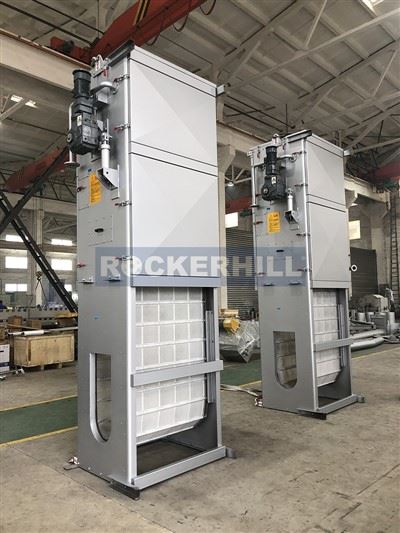
To specify a demineralized water skid, define five things: the feed water analysis, the product water quality, the capacity and demand pattern, the redundancy, and the site and code requirements. With these, a manufacturer can select the right treatment train (ion exchange, RO + mixed bed, RO + EDI or UF + RO + EDI) and guarantee product water quality against your feed water.
Incomplete specifications are the main reason demineralized water quotations are hard to compare: one supplier sizes for average demand, another for peak; one assumes clean municipal water, another allows for seasonal turbidity. This guide gives a step-by-step method and an RFQ checklist, illustrated with two ROCKERHILL projects delivered in 2026: a 30 t/h UF + RO + EDI + PMB ultrapure water skid for Seiko Epson in Singapore and a 2 × 100 t/d ion exchange skid for BP's Zhuhai petrochemical base.

Step 1: Get a full feed water analysis
The feed water analysis decides the pretreatment, the main process and the guaranteed product quality. Include at least:
|
Parameter |
Why it matters |
|
TDS / conductivity |
Chooses between ion exchange and RO; sets chemical consumption |
|
Hardness (Ca, Mg) |
Scaling risk for RO; load on cation resin |
|
Alkalinity, CO2 |
Load on anion resin or EDI; need for a degasser |
|
Silica (reactive and colloidal) |
Critical for boilers and electronics; RO scaling |
|
Chloride, sulfate, sodium |
Ionic load; corrosion |
|
Iron, manganese |
Membrane and resin fouling |
|
Free chlorine |
Damages RO membranes and resin |
|
Turbidity, SDI, TSS |
Pretreatment selection (MMF or UF) |
|
TOC |
Fouling; critical for ultrapure water |
|
Temperature range |
RO flux and EDI performance; seasonal design |
|
Variability |
Surface water and reclaimed water vary more than well or municipal water |
Tip: provide at least two analyses from different seasons for surface water sources.
Step 2: Define product water quality
State the required values and the standard they come from. Common end uses:
|
End use |
Typical focus |
|
Boiler feed water |
Conductivity, silica, sodium, hardness; limits rise with boiler pressure |
|
Electronics and semiconductors |
Resistivity, TOC, particles, silica, bacteria |
|
Hydrogen electrolyzers |
OEM specification for conductivity and impurities |
|
Pharmaceutical |
Pharmacopeia requirements for purified water |
|
Chemical process water |
Process-specific ion limits |
On the Epson project, the product water served electronics manufacturing with very strict quality requirements, so the train ended with EDI and a polishing mixed bed. On the BP Zhuhai project, the water served petrochemical production including boiler feed, so a cation, anion and mixed bed ion exchange train was used.
Step 3: Size the capacity
- Net product flow at peak and average demand
- Operating pattern: continuous, daytime only or batch
- Storage: a demineralized water tank sized to cover peaks, regeneration periods and short outages
- Future expansion: space and tie-ins for an extra train
For RO-based systems, the raw water demand is higher than the product flow because of the RO reject stream; for ion exchange, regeneration and rinse water must be included.
Step 4: Decide on redundancy
Ask what happens if one train is offline:
|
Arrangement |
When to use |
|
1 × 100% with storage |
Non-critical supply, short maintenance windows |
|
2 × 100% (one duty, one standby) |
Critical supply such as boiler feed water |
|
2 × 50% or 3 × 50% |
Large systems that need partial output during maintenance |
ROCKERHILL's BP Zhuhai skid uses a dual-parallel layout of 2 × 100 t/d: when one unit is maintained, the other continues supplying water.
Step 5: Choose the treatment train
|
Treatment train |
Best for |
|
MMF + ACF + CB + AB + MB (ion exchange) |
Low-TDS feed, plants already handling acid and caustic, robust boiler feed supply (e.g. BP Zhuhai) |
|
Pretreatment + RO + MB |
Higher-TDS feed; very low silica for high-pressure boilers |
|
Pretreatment + RO + EDI |
Continuous supply without regeneration chemicals |
|
UF + RO + EDI + PMB |
Variable or surface feed water; ultrapure water for electronics (e.g. Epson) |
Step 6: Define site, utilities and codes
- Indoor or outdoor installation, ambient temperature range, available footprint and headroom
- Power supply voltage and frequency; hazardous area classification
- Chemical storage and neutralization requirements (for ion exchange)
- Drain capacity and wastewater discharge limits
- Codes: ASME / CRN for vessels and piping where required; UL 508A / NEC for the USA; CE for Europe
- Shipping limits: container or break-bulk
Step 7: Specify controls, testing and documentation
- PLC and HMI preference, and interface to the plant DCS
- Online analyzers (conductivity/resistivity, silica, TOC, pH, ORP) and automatic off-spec diversion
- Factory acceptance test scope and witness points
- Documentation: P&ID, GA, electrical drawings, O&M manuals, spare parts list
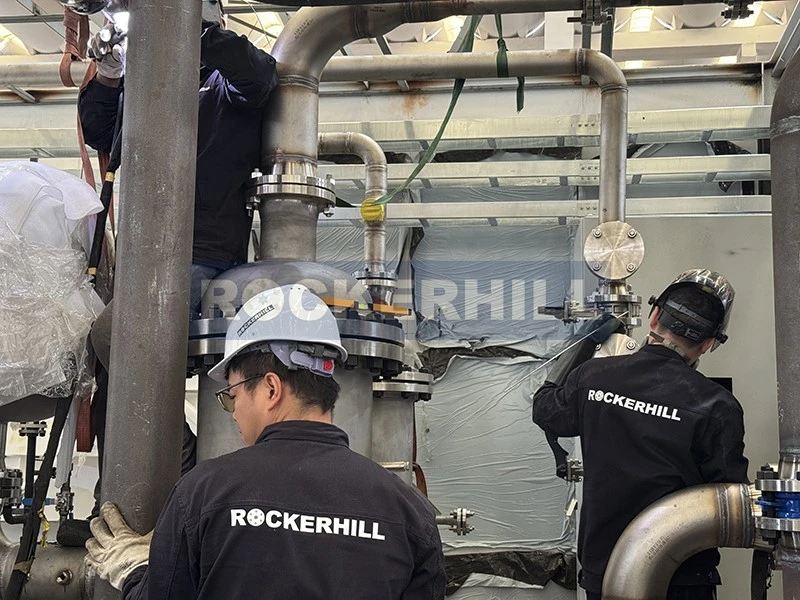
On the Epson project, the complete skid, including UF, RO, EDI and PMB units, control systems, pipelines and valves, was prefabricated, assembled and commissioned in ROCKERHILL's factory, so the site needed only water and electrical connections.
Demineralized water skid RFQ checklist
- Feed water analysis (two seasons if surface water)
- Product water specification and governing standard
- Peak and average flow, operating pattern
- Storage volume, or let supplier size it
- Redundancy (1 × 100%, 2 × 100%, 3 × 50%)
- Preferred or excluded processes (e.g. no on-site acid and caustic)
- Site: indoor/outdoor, ambient range, footprint
- Utilities: voltage, frequency, air, drain
- Wastewater and regeneration waste limits
- Codes and certifications
- Control system and plant interface
- FAT, commissioning, training and spare parts scope
- Delivery date and shipping destination
ROCKERHILL demineralized water references
|
Project |
Capacity |
Process |
Delivered |
|
Seiko Epson, Singapore |
30 t/h |
UF + RO + EDI + PMB |
June 2026 |
|
BP Zhuhai petrochemical, China |
2 × 100 t/d |
MMF + ACF + CB + AB + MB |
May 2026 |
|
Gansu Tianshui Huatian Technology |
150 m³/h |
MMF + UF + RO + EDI |
[year] |
|
Shanghai Chenguang Polymer Materials |
50 m³/h |
MMF + ACF + two-pass RO + EDI |
2014 |
|
Hunan Jinhongtai |
2 × 50 m³/h |
MMF + UF + RO + mixed bed |
2017 |
About ROCKERHILL
ROCKERHILL is a designer and manufacturer of demineralized water skids and custom process skids, with references including a 30 t/h ultrapure water skid for Seiko Epson in Singapore, a petrochemical water treatment skid for BP Zhuhai, an ASME-coded CO2 carbon capture skid for Canada and an H2O2 production skid for the USA. Product water quality is guaranteed in each proposal against the client's feed water analysis. Every skid is factory tested before shipment and comes with commissioning support, training, a spare parts list and an 18-month warranty.