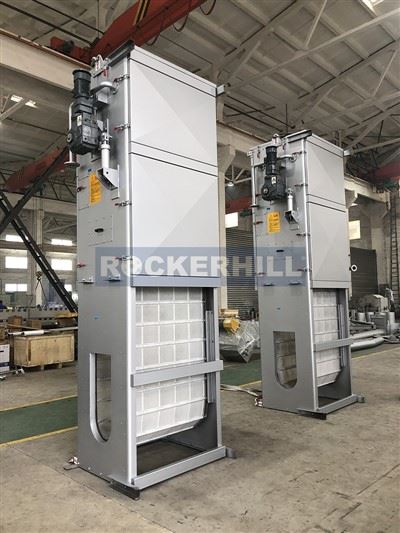
An ion exchange demineralizer removes dissolved salts from water by passing it through resin beds that swap unwanted ions for hydrogen (H+) and hydroxide (OH-) ions, which combine to form pure water. A typical train for boiler feed water is multimedia filter (MMF), activated carbon filter (ACF), cation bed (CB), anion bed (AB) and mixed bed (MB). It is a proven, shock-tolerant process widely used in chemical and petrochemical plants.
ROCKERHILL, a designer and manufacturer of demineralized water and custom process skids, delivered a 2 × 100 t/d MMF + ACF + CB + AB + MB water treatment skid to BP's Zhuhai petrochemical base in China in May 2026, supplying industrial pure water for production, including boiler feed water. This guide explains how the process works, when to choose ion exchange instead of RO, and how to design for reliability.


Why boilers need demineralized water
Dissolved minerals in boiler feed water cause scale on heat transfer surfaces, corrosion, and carryover of silica and salts into steam, which can deposit on turbines and process equipment. The higher the boiler pressure, the stricter the feed water limits. Plant operators typically set limits for conductivity, silica, hardness, sodium and iron, based on the boiler manufacturer's requirements and guidance such as the ASME consensus guidelines on boiler feed water chemistry.
How the MMF + ACF + CB + AB + MB train works
|
Stage |
Function |
|
MMF (multimedia filter) |
Removes suspended solids and turbidity to protect downstream beds |
|
ACF (activated carbon filter) |
Removes free chlorine and organics that would damage or foul ion exchange resin |
|
CB (cation bed) |
Strong acid cation resin exchanges calcium, magnesium, sodium and other cations for H+ |
|
AB (anion bed) |
Strong base anion resin exchanges sulfate, chloride, bicarbonate and silica for OH- |
|
MB (mixed bed) |
Mixed cation and anion resin polishes remaining ions to reach final purity |
The cation and anion beds remove the bulk of the dissolved salts. The mixed bed then acts as a polisher. When properly operated, mixed bed polishers commonly produce water with very low conductivity and low silica, suitable for medium and high-pressure boilers. [BP Zhuhai product water values, if publishable.]
Many systems also include a degasser between the cation and anion beds to strip carbon dioxide and reduce the load on the anion resin; whether it pays off depends on the feed water alkalinity.
Regeneration
When the resin is exhausted, each bed is regenerated: cation resin with acid (typically hydrochloric or sulfuric acid) and anion resin with caustic soda. The regeneration waste is neutralized before discharge. Automatic regeneration sequences, controlled by the skid PLC, keep operator involvement low.
Ion exchange or RO? When ion exchange makes sense
|
Situation |
Better fit |
|
Low-TDS feed water |
Ion exchange is efficient, because chemical use rises with TDS |
|
High-TDS or brackish feed |
RO first, then polishing |
|
Plant already handles acid and caustic |
Ion exchange adds little new chemical risk |
|
Variable feed water quality or shock loads |
Ion exchange is robust and tolerant |
|
Need to minimize wastewater volume |
Ion exchange typically rejects less water than RO |
|
Need to avoid on-site chemicals |
RO + EDI |
|
Small or moderate demand |
Ion exchange is compact and simple |
Petrochemical plants often have low-to-moderate-TDS feed water, existing acid and caustic handling, and a strong preference for proven, stable processes. That is why MMF + ACF + CB + AB + MB remains a standard choice in the chemical industry.
Designing for reliability: the dual-parallel layout
Boiler feed water cannot stop. On the BP Zhuhai project, ROCKERHILL used a dual-parallel layout with two 100 t/d units. When one unit is offline for regeneration or maintenance, the other keeps supplying water, so production continues without interruption.
Other reliability features to specify:
- Online conductivity and silica monitoring with automatic changeover to the standby train
- Demineralized water storage sized to cover regeneration time
- Automatic regeneration with chemical dosing and neutralization
- Resin traps and strainers to protect downstream equipment
- Corrosion-resistant materials for acid and caustic service
Case study: BP Zhuhai petrochemical water treatment skid, China
|
Item |
Detail |
|
Client |
BP Zhuhai Branch |
|
Location |
Zhuhai, China |
|
Capacity |
2 × 100 t/d (200 t/d total) |
|
Process |
MMF + ACF + CB + AB + MB |
|
Layout |
Dual-parallel; one unit continues while the other is maintained |
|
Delivery |
May 2026 |
|
Application |
Industrial pure water for petrochemical production, including boiler feed water |
|
Performance |
Strong resistance to shock loads, stable product water quality |
[Add project photos with descriptive alt text, e.g. "2 × 100 t/d ion exchange demineralized water skid at BP Zhuhai petrochemical base".]
Read the project page: [link to BP ZhuHai Petrochemical Water Treatment Skid project].
Other ROCKERHILL demineralized water references
- Seiko Epson, Singapore: 30 t/h UF + RO + EDI + PMB ultrapure water skid for electronics manufacturing, delivered June 2026. [link to Article 13]
- Shanxi Pingshuo Coal Gangue Power Plant: UF and RO with cation, anion and mixed bed polishing.
- Hunan Jinhongtai: 2 × 50 m³/h MMF + UF + RO + mixed bed.
About ROCKERHILL
ROCKERHILL is a designer and manufacturer of demineralized water skids and custom process skids, with references including a petrochemical water treatment skid for BP Zhuhai, a 30 t/h ultrapure water skid for Seiko Epson in Singapore, an ASME-coded CO2 carbon capture skid for Canada and an H2O2 production skid for the USA. Every skid is factory tested before shipment and comes with commissioning support, training, a spare parts list and an 18-month warranty.