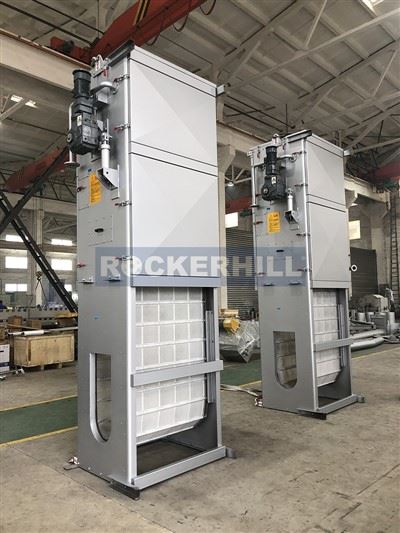
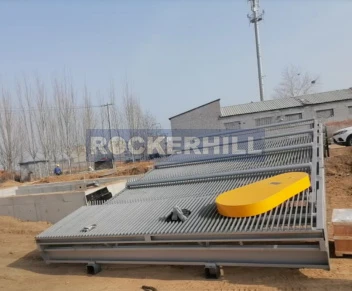
When you design a spillway, barrage, flood-control sluice or irrigation check structure, one of the earliest decisions is the gate type. The two most common choices are the radial gate (called a tainter gate in the USA) and the vertical lift gate. Both can do the job. The right choice depends on span, head, available headroom, budget and how the structure will be operated for the next 50 years.
ROCKERHILL designs and manufactures both. Our gates operate on projects in the United States, Canada, Australia and Singapore, as well as in Croatia, Mexico and the Middle East. Here is how we compare the two for our clients, what a radial gate datasheet and specification should contain, and how we engineer the gate behind them.


How each gate works
- Radial gate. The skinplate is a curved section of a cylinder, supported by arms that pivot on trunnions anchored to the piers. Because the skinplate is curved around the trunnion axis, the resultant water force passes through (or very close to) the trunnion. The hoist only has to overcome the gate's weight and friction at the trunnion and seals, not the full water load.
- Vertical lift gate. A flat (or slightly curved) leaf slides or rolls vertically in slots in the piers. The full hydrostatic load is carried by wheels or slide blocks bearing on embedded tracks, and the hoist must overcome the weight of the leaf plus the friction generated by that load.
Side-by-side comparison
|
Factor |
Radial (tainter) gate |
Vertical lift gate |
|
Hoist force |
Lower. Water load passes near the trunnion |
Higher. Must overcome friction under full water load |
|
Gate slots in piers |
Not needed. Smooth piers, better hydraulics |
Required. Slots can cause cavitation at high velocity |
|
Headroom above deck |
Low. Gate rotates up and back |
High. Leaf must lift clear of the flow, often needing a tall hoist structure |
|
Pier length |
Longer, to accommodate the arms and trunnions |
Shorter |
|
Trunnion loads |
Large concentrated loads into the piers, needing anchorage design |
Loads spread along the gate slots |
|
Flow regulation |
Excellent. Smooth undershot discharge at partial opening |
Good, but vibration risk at small openings |
|
Maintenance |
Trunnion bearings and side seals; gate stays in place |
Wheels, tracks and seals; leaf can be lifted out for inspection |
|
Typical uses |
Spillways, barrages, flood-control sluices, irrigation checks |
Intakes, outlets, deep sluices, bulkheads and stoplogs |
When a radial gate is the better choice
- Wide spans and moderate heads. A radial gate handles wide openings with a lighter hoist. ROCKERHILL's standard range covers gate widths from 0.8 to 15 m and heads up to 80 m, and larger gates are designed to order.
- Limited headroom or a low profile. Radial gates suit urban rivers, landscaped waterfronts and theme parks, where a tall hoist tower is not acceptable. ROCKERHILL supplied two 15 m × 3.2 m radial gates for the Beijing Universal Theme Park and Resort.
- Frequent regulation. For canal and river level control, radial gates give smooth, controllable discharge with low hoist power.
- High-velocity flow. No gate slots means no slot cavitation.
When a vertical lift gate is the better choice
- High heads and deep submergence, such as low-level outlets and intakes, where a radial gate's arms and trunnions become very large.
- Short piers or tight sites, where there is no room for radial arms.
- Gates that must be removed for maintenance, or that double as bulkheads.
Cost considerations
Steel weight is not the whole story. When you compare costs, look at the whole structure:
- Gate and embedded parts. Radial gates often use less steel for the same opening, but trunnion assemblies and anchorages are precision items.
- Hoist. A radial gate's lower hoist force often allows a smaller hydraulic cylinder or wire-rope hoist, reducing equipment and power costs.
- Civil works. Radial gates need longer piers and trunnion anchorage. Vertical lift gates need slots, embedded tracks and a taller hoist deck or tower.
- Lifetime operation. Hoist power, seal replacement and corrosion protection over 30 to 50 years often outweigh the initial price difference.
Datasheet: ROCKERHILL radial gate
Standard size classes
Four standard size classes cover most sluices and spillways. Anything outside them is designed to order.
|
Size class |
Gate width (m) |
Water head (m) |
Hoist |
Gate weight (t) |
|
Small |
0.8 – 3 |
< 6 |
Manual / electric |
0.2 – 3 |
|
Medium |
3 – 10 |
6 – 30 |
Electric |
3 – 50 |
|
Large |
10 – 15 |
30 – 80 |
Electric |
50 – 250 |
|
Customized |
To project |
To project |
Manual / electric |
To project |
Materials and corrosion protection
|
Material group |
Grades |
Corrosion protection options |
|
Carbon steel |
A36, A572, Q235B, Q345B |
Zinc spray coating, sacrificial anode blocks, anti-corrosion paint |
|
Stainless steel |
SS304 |
Zinc spray coating, sacrificial anode blocks |
|
Stainless steel |
SS316, SS316L |
Sacrificial anode blocks |
|
Alloy |
Aluminium alloy |
Zinc spray coating, sacrificial anode blocks, anti-corrosion paint |
|
Customized |
To project specification |
To project specification |
Hydraulic cylinders suit gates that must hold intermediate positions precisely and work well with remote SCADA control. Wire-rope hoists are simple and robust, and are easy to maintain locally. Operating modes include manual, electric, remote and automatic control.
Design engineering: how we size a radial gate
A radial gate is a structural, mechanical and hydraulic system. Every ROCKERHILL gate is designed around its site:
- Site and foundations. Terrain and soil conditions set the installation and foundation requirements, including trunnion anchorage into the piers.
- Hydraulics. Flow rate, water pressure and seasonal variation are analysed so the gate handles the full range of conditions, from normal regulation to flood discharge.
- Function. The project purpose (water storage, flood control or irrigation) drives the operating mode, opening speed and control philosophy.
- Structure. Skinplate, horizontal girders, radial arms and trunnions are designed by calculation to the project code. US projects often reference USACE guidance for tainter gate design; we also work to ASTM, ASME, EN and GB specifications.
- Seals and cold climate. Side and bottom seals are selected for the water quality, temperature and any ice exposure, which matters in Canada and the northern USA.
- Maintenance access. Future expansion and inspection access are planned in from the start.
Engineering drawings we deliver
Every radial gate order comes with a full drawing set, issued for approval:
- General arrangement: lateral views with the gate fully closed and fully open, front view and top view.
- Gate leaf and arm elements: element details and cross sections of the skinplate, girders, arms and trunnion.
Why a designer-manufacturer matters
When design and fabrication are split between companies, tolerances on trunnion alignment and seal contact are where problems appear on site. At ROCKERHILL, one team owns the gate from first calculation to factory test. Our engineers join at the design and planning stage, for new builds and for upgrades. Fabrication takes place in our own workshops under strict quality control, and on renovation projects we work to keep disruption to operations low.
Track record
Our radial gates and related water control equipment are in service from North America to Australia and Singapore. Selected completed radial gate projects:
|
Project |
Gate size |
Location |
|
Aquatech project |
Radial gates, with stoplogs and a cooling water intake screen for the same plant |
Mexico |
|
REP. 27+016 C. Reforma |
6 m × 3 m (2 leaves) |
Mexico |
|
Beijing Universal Theme Park and Resort |
15 m × 3.2 m (2 sets) |
Beijing, China |
|
ADB-loan Pingxiang urban-rural infrastructure, Tankou and Qinghua River gates |
12 m × 2.3 m (2 sets), 12 m × 1.2 m (2 sets), 17 m × 2 m (3 leaves) |
Pingxiang, China |
|
Shuangji River Shuanglongba project |
18 m × 1.5 m (3 leaves) |
Xinzheng, China |
|
Chengnan River water quality improvement |
15 m × 2.5 m (2 sets) |
Nanjing, China |
|
Moat ring project |
Radial gate 10.8 m × 2 m, miter gate 9.2 m × 2.5 m |
Xuchang, China |
|
Xuhe drainage pumping station flood-control sluice |
9.0 m × 4.7 m (6 leaves) |
Hefei, China |
|
Qinhuai River water environment improvement |
10 m × 1.5 m (2 leaves) |
Nanjing, China |
The Pingxiang project, financed by an Asian Development Bank loan, is a good example of international procurement: seven gates in three sizes up to 17 m wide, procured under an Asian Development Bank loan. The full reference list, including projects in Canada, Croatia, Singapore, Australia and the Middle East, is available on request.
Frequently asked questions
- What is the difference between a radial gate and a tainter gate? None. "Tainter gate" is the common US name for a radial gate, after the engineer Jeremiah Burnham Tainter.
- Why does a radial gate need less hoist force? The curved skinplate directs the water force through, or near, the trunnion pin, so the hoist mainly lifts the gate's own weight rather than fighting the water load.
- How wide can a radial gate be, and for what head? ROCKERHILL's standard range is 0.8 to 15 m wide for heads up to 80 m, and larger gates are designed to order.
- Are radial gates suitable for cold climates? Yes, with appropriate seals, heating of side seals or embedded parts where needed, and steels selected for low-temperature toughness.
- What do you need for a radial gate quotation? Gate width and height, sill level, design and check water levels upstream and downstream, pier dimensions, operating mode, hoist preference, material and corrosion protection, quantity and delivery location.