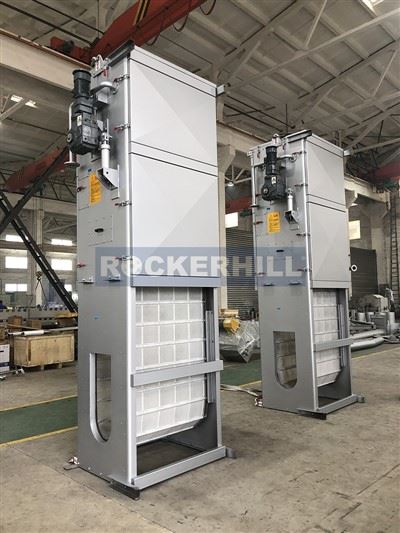
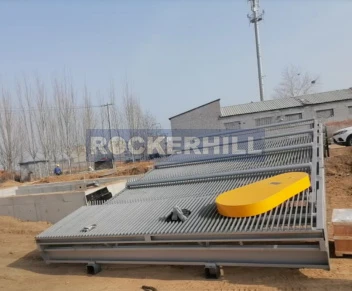
A traveling water screen (also called a traveling band screen) is a moving loop of mesh panels that filters raw water at an intake, lifts debris out of the flow and washes it off at the deck. It protects pumps, condensers and desalination pretreatment at power plants, SWRO plants and river intakes. The three main arrangements are through-flow, dual-flow and center-flow. They differ in one thing: which way water crosses the band, and which side of the mesh keeps the debris.
Flow paths compared

plan view · 3 flow paths
Schematic plan view of the three traveling water screen flow paths, not to scale.
Through-flow traveling water screen
In a through-flow traveling water screen, the band sits across the channel and water is filtered through the upstream face. Debris stays on that face and is washed off at deck level
Best for: existing chambers built for through-flow and moderate flows. Limit: screen width equals channel width, and carry-over can send debris to the clean side.
Dual-flow traveling water screen
A dual-flow traveling band screen is turned 90 degrees, so the band runs parallel to the flow. Water enters through both faces and leaves at one end: "double entry, single exit". Best for: high flow in a narrow channel, and heavy debris. Two filtering faces give a smaller screen for the same duty, and WTR offers dual-flow conversion screens that fit existing through-flow chambers. Limit: one manufacturer reports debris build-up at the channel bottom.
Center-flow traveling band screen
A center-flow traveling water screen filters from the inside out: "single entry, double exit". Debris stays on the inside of the band.
Best for: fine screening, slippery debris such as plastic film, sewage headworks and industrial intakes.
Comparison
|
Through-flow |
Dual-flow |
Center-flow |
|
|
Band position |
Across the channel |
Parallel to flow |
Parallel to flow |
|
Water path |
Through upstream face |
In through both faces, out one end |
In at front, out through both faces |
|
Debris held on |
Upstream face |
Outside of both faces |
Inside of the band |
|
Typical use |
Existing chambers |
Raw water intakes |
Fine screening, headworks |
How to choose
- Existing chamber, no civil changes: through-flow, or a dual-flow conversion screen.
- Narrow channel, high flow or heavy debris: dual-flow.
- Fine mesh or slippery debris: center-flow.
- Fish protection under 316(b): dual-flow, conversion or through-flow, with fish buckets and low-pressure fish spray.
FAQ
Is center-flow the same as dual-flow? No. Dual-flow is double entry, single exit. Center-flow is single entry, double exit, with debris held inside the band.
What is carry-over? Debris that stays on the band past the wash and falls into the screened water. Dual-flow and center-flow designs help reduce it.
What mesh size does a traveling water screen use? It depends on the debris and the equipment protected. Aqseptence gives 200 µm to 10 mm for center-flow screens, and NRC fish studies used about 0.5 to 3.0 mm.
Get a quote
Rockerhill has such project references globally, and rockerhill design and manufactures traveling water screens and traveling band screens for river, seawater and cooling water intakes. Send your flow rate, channel drawing, water levels, mesh size and material (SS304, SS316L or duplex) to Allie.s@rockerhillcn.com.