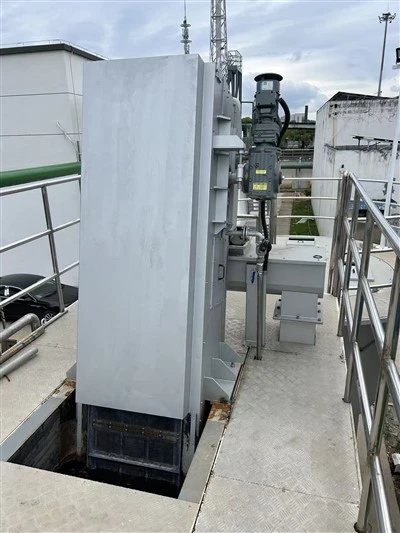
The band screen mesh size at a seawater reverse osmosis (SWRO) intake is the opening of the mesh panels on the traveling screens that remove marine debris and organisms before the seawater pumps, and it is usually chosen between 1 mm and 5 mm. The choice sets how much debris reaches the pretreatment, how many fish eggs and larvae are drawn in, how large the screens must be and how hard they work during a jellyfish or algae event.
There is no single correct mesh size. A 5 mm screen is smaller, cheaper and more tolerant of debris surges. A 1 mm screen protects the pretreatment and marine life better, but needs more screen area, more wash water and better materials. This article explains how to choose, with a decision table at the end. It builds on our guides to band screen flow patterns and cooling water intake screen design, and focuses on what is different about desalination.
Where the band screen sits in an SWRO intake
|
Stage |
Typical equipment |
Typical opening |
Job |
|
1. Intake structure |
Velocity cap, intake head or open channel |
Bars at the intake head, often 100 to 300 mm |
Keeps out large objects and limits the velocity at which fish are drawn in |
|
2. Coarse screening |
Trash rack or coarse bar screen with rake cleaner |
Commonly 20 to 100 mm |
Removes weed, timber, plastics and large debris |
|
3. Fine screening |
Traveling band screens or drum screens |
1 to 5 mm |
Removes shells, jellyfish, weed fragments, small fish and plastics before the intake pumps |
|
4. Pretreatment |
Self-cleaning strainers, then dissolved air flotation, media filters or ultrafiltration |
Strainers often 100 to 300 µm ahead of UF |
Removes suspended solids and organics |
|
5. Final protection |
Cartridge filters |
About 5 µm |
Protects the RO membranes |
The band screen is the last mechanical screen before the pumps. Anything it passes goes into the pumps, the pipelines and the pretreatment, so its mesh size must be chosen together with stage 4.
The three options compared
The open area of square woven mesh is approximately (a / (a + d))², where a is the aperture and d the wire diameter. The figures below use typical wire diameters; the actual values depend on the mesh chosen.
|
Criterion |
1 mm mesh |
2 mm mesh |
5 mm mesh |
|
Typical open area (with 0.5 / 0.8 / 1.2 mm wire) |
About 44% |
About 51% |
About 65% |
|
Screen area for the same flow and velocity |
Largest (about 1.5 times the 5 mm screen) |
Medium |
Smallest |
|
Fish eggs and larvae |
Excludes many eggs and larger larvae |
Excludes some |
Passes most eggs and larvae |
|
Shell fragments and small mussels |
Removed |
Mostly removed |
Small shells pass |
|
Load on downstream strainers and pretreatment |
Lowest |
Moderate |
Highest |
|
Blinding during jellyfish or algae events |
Fastest; needs high-speed rotation and strong spray wash |
Moderate |
Slowest |
|
Wash water demand |
Highest |
Medium |
Lowest |
|
Mesh durability |
Finest wire, most vulnerable to wear and damage |
Medium |
Most robust |
|
Typical fit |
Locations with strict marine life rules; UF pretreatment; new large plants |
General-purpose choice for many SWRO plants |
Older plants, heavy debris sites, robust media filter pretreatment |
Five factors that decide the mesh
1. Marine life regulations
In some jurisdictions the mesh size is set by law, not by engineering. The best known example is California, where the Ocean Plan desalination amendment requires surface water intakes for new and expanded desalination plants to use screens with a slot size of 1.0 mm or smaller and a through-screen velocity of no more than 0.15 m/s (0.5 ft/s), to reduce the entrainment and impingement of marine life. Environmental permits elsewhere increasingly follow similar thinking, especially near sensitive habitats.
If a rule like this applies, the mesh is 1 mm and the remaining question is how much screen area is needed to meet the velocity limit. Check the current rules for your site early, because they can double the screen size.
2. The pretreatment process
The finer the pretreatment, the more it benefits from fine screening ahead of it.
|
Pretreatment |
Effect on band screen mesh choice |
|
Media filtration (single or dual media) |
Tolerant of coarser solids. 2 to 5 mm mesh is common, with self-cleaning strainers ahead of the filters where needed |
|
Dissolved air flotation + media filtration |
Similar to media filtration; DAF also handles algae well. 2 to 5 mm |
|
Ultrafiltration (UF) |
UF membranes need protection by self-cleaning strainers, often 100 to 300 µm. A finer band screen (1 to 2 mm) reduces the load and backwash frequency of those strainers |
A coarser band screen does not remove the need for fine strainers. It moves the work from the band screen to the strainers. That can be the right trade if the strainers are robust and the debris load is light, but at sites with heavy shell or weed loads, strainers clogging with debris a band screen would have caught is a common operating complaint.
3. Debris type and seasonal events
Look at what actually arrives at the intake through the year, ideally from a survey or from a nearby intake:
Jellyfish blooms can blind a fine screen within minutes. A 1 mm screen needs high-speed rotation, a strong spray wash and a debris trough sized for a sudden surge.
Seaweed and seagrass after storms wrap around coarse elements and blind fine mesh.
Mussels, barnacles and shells settle inside intake pipes and break off; small shells pass 5 mm mesh and can damage pumps and strainers.
Algal blooms mostly pass any band screen and are a pretreatment problem, but filamentous algae can blind fine mesh.
At sites with severe bloom events, some designers use 2 or 3 mm mesh with very generous screen area as a compromise, or install a dual-flow or centre-flow screen design that keeps debris away from the clean side.
4. Through-screen velocity and screen size
The screen area must keep the through-mesh velocity within the design limit at the lowest sea level (lowest astronomical tide, minus any allowance for storm drawdown) and the highest intake flow. The velocity is calculated on the effective open area of the submerged mesh, not the gross panel area:
Through-mesh velocity = Q / (submerged panel area × open-area fraction × (1 − blinding allowance))
Because 1 mm mesh has less open area than 5 mm mesh, it needs a larger screen, or more screens, for the same velocity. Where no regulatory limit applies, designers often keep the clean through-mesh velocity well below about 0.5 m/s to limit head loss and blinding. Where a 0.15 m/s limit applies, it nearly always controls the screen size.
5. Materials and biofouling
Seawater is aggressive to mesh, and fine mesh has thin wires with little corrosion allowance.
|
Component |
Common materials for SWRO intakes |
|
Mesh |
Super duplex stainless steel (such as 2507), 6% molybdenum austenitic steel, or polymer mesh (polyamide or polyester) on stainless frames |
|
Panel frames, chains and structure |
Duplex 2205 or super duplex 2507 stainless steel; coated carbon steel with cathodic protection for heavy structure above water |
|
Spray headers and nozzles |
Super duplex or suitable polymer |
AISI 304 and 316L are generally not sufficient for submerged parts in warm seawater, where they are prone to pitting and crevice corrosion. Copper-nickel mesh resists biofouling and is used at some power station intakes, but at RO plants check with the membrane supplier before using copper-bearing materials upstream of the membranes.
Shock chlorination at the intake controls mussel and barnacle growth, but the chlorine must be removed before the RO membranes, so coordinate the dosing point with the process designer.
Decision table
|
Your situation |
Mesh size to start from |
|
A 1 mm slot size is required by permit or regulation |
1 mm, sized for the velocity limit |
|
UF pretreatment, moderate debris, no regulatory limit |
1 to 2 mm |
|
Media or DAF pretreatment, moderate debris |
2 mm (or 3 mm) |
|
Heavy, frequent jellyfish or weed surges, robust strainers downstream |
3 to 5 mm, with generous screen area |
|
Retrofit of an existing intake where the screen size cannot grow |
Keep the existing mesh, or go finer only after a velocity and head loss check |
|
Shell fragments damaging pumps or strainers at present |
Go finer, typically to 2 mm or less |
Wash system and debris handling
A fine mesh screen is only as good as its spray wash. For SWRO intakes, specify:
Two spray systems where marine life protection matters: a low-pressure spray to wash fish and organisms gently into a return trough, and a high-pressure spray to remove debris.
Variable rotation speed, controlled by differential level across the screen, with a high-speed mode for bloom events.
A debris trough and channel sized for the peak surge, not the average day, discharging to a basket, compactor or return channel.
Isolation of each screen bay with stoplogs or gates, so a screen can be removed while the others keep running.
Specification checklist
Maximum and minimum intake flow, and the number of screens and standby units
Design sea levels: highest and lowest, including storm surge and drawdown
Required mesh opening, and any regulatory slot size or velocity limit
Pretreatment type and the strainer opening downstream
Debris survey: jellyfish, weed, shells, plastics and seasonal events
Seawater temperature, salinity and chlorination regime
Materials for mesh, frames, chains and structure
Spray wash pressures and water source, fish return requirements
Head loss limit, differential level control and alarms
Isolation, lifting and maintenance access requirements
Design, engineering and in-house manufacturing
ROCKERHILL designs and builds band screens, bar screens and the gates and stoplogs that isolate them, for seawater and fresh water duty.
|
Capability |
What it means for your project |
|
In-house design and engineering |
Our engineers size the screen area at your lowest design water level, select mesh and materials, and check the through-mesh velocity and head loss before proposing a screen. |
|
Seawater materials |
Duplex 2205 and super duplex stainless steel, mesh or perforated plate panels to the specified opening, and coating systems for coastal duty. |
|
Project documentation |
General arrangement drawings, data sheets, structural calculations, ITPs, O&M manuals and spare parts lists, issued for approval before fabrication. |
|
Codes and standards |
ASTM, ASME, EN and GB codes or the project specification; welding to ASME Section IX; EN 10204 3.1 material certificates. |
|
In-house manufacturing |
Cutting, welding, machining, and pickling and passivation of stainless steel in our own workshops in China, under our own quality control. |
|
Factory testing |
Screens are fully assembled and run in the factory before shipment, witnessed by the client or recorded on video. Third-party inspection is welcome. |
|
One supplier for the intake |
Trash racks and coarse screens, band screens, stoplogs, sluice gates and radial gates from one engineering team. |
Global project references
ROCKERHILL has project references in 30 countries, including intake, coastal and seawater projects. Selected references:
|
Project |
Scope |
Location |
|
Aquatech project |
Cooling water intake screen, with stoplogs and radial gates for the same plant |
Mexico |
|
National Water Administration |
Band screen and bar screen, with penstocks |
Croatia |
|
PPLAK project |
4 sets of AISI 316L stainless steel bar screens for a coastal, high-chloride environment |
Singapore |
|
Petrochemical park cooling water system |
12 sets of super duplex 2507 seawater check gates, 2,000 × 2,500 mm |
Saudi Arabia |
|
Colombo power plant |
Cooling and river water supply gates |
Colombo, Sri Lanka |
|
Nancun waterworks inlet well, South-to-North Water Diversion |
GQ-B multi-rake bar screen for a 4,800 mm wide channel, 7,347 mm deep |
Shijiazhuang, China |
ROCKERHILL's wider engineering references include an ASME-coded CO₂ carbon capture skid for Canada, an H₂O₂ production skid for the USA and fish gates for a fish passage project in Australia. The full reference list is available on request.
Frequently asked questions
What mesh size is used for SWRO intake band screens? Usually between 1 mm and 5 mm. 1 mm is used where marine life rules require it or ahead of UF pretreatment, 2 mm is a common general choice, and 3 to 5 mm suits heavy debris sites with robust pretreatment.
Is 1 mm mesh required for desalination intakes? In some places, yes. California's Ocean Plan requires a slot size of 1.0 mm or smaller and a through-screen velocity of no more than 0.15 m/s for surface intakes of new and expanded desalination plants. Check the rules for your site.
Does a finer band screen mean I don't need strainers? No. Even a 1 mm band screen passes particles far larger than UF membranes or media filters accept, so self-cleaning strainers are still needed. A finer band screen reduces their load.
How much bigger is a 1 mm screen than a 5 mm screen? For the same flow and velocity, roughly 1.5 times the submerged mesh area, because 1 mm mesh has less open area. A regulatory velocity limit can make it larger still.
What material should SWRO band screen mesh be? Super duplex stainless steel, 6% molybdenum steel or polymer mesh. 304 and 316L are generally not suitable for submerged parts in warm seawater.
How do band screens cope with jellyfish? With generous screen area, variable and high-speed rotation, strong spray wash and a debris trough sized for surges. Coarser mesh blinds more slowly.
Band screen or drum screen for a desalination intake? Band screens suit most intake channels and are easy to isolate in bays. Drum screens suit very large flows. Both can use 1 to 5 mm mesh.
What through-screen velocity should I use? Where a fish protection rule applies, often 0.15 m/s. Otherwise designers usually keep the clean velocity well below about 0.5 m/s at the lowest sea level.
Does ROCKERHILL make band screens for seawater? Yes. ROCKERHILL designs and builds band screens, bar screens and isolation gates in duplex and super duplex stainless steel, with references including a cooling water intake screen in Mexico and seawater gates in Saudi Arabia.
Planning or upgrading a seawater intake? Send your intake flow, sea levels, pretreatment type and debris data to ROCKERHILL. Our engineers will recommend a mesh size and return a sized band screen proposal. Contact Allie at Allie.s@rockerhillcn.com.
Author: Allie Shen, ROCKERHILL. Last updated: Nov 18,2026.