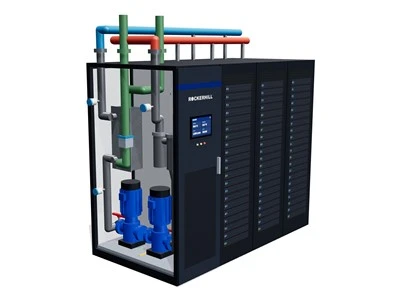
Reverse Osmosis (RO) is a membrane-based water purification process that removes up to 99.5% of dissolved salts, organic contaminants, bacteria, and particles from water. It works by applying hydraulic pressure on the feed water to push it through a semi-permeable membrane, allowing only clean water molecules (permeate) to pass, while rejecting contaminants (concentrate/brine).
It is one of the most widely used technologies in industrial, commercial, and municipal water treatment systems.
How Does Reverse Osmosis Work?

Process of Reverse Osmosis
1. Pre-Treatment- Feed water passes through:
- Sediment Filters – remove dirt, silt, and suspended solids
- Activated Carbon Filters – remove chlorine and organics that degrade membranes
- Softening or Antiscalant Dosing – reduces scaling by removing calcium/magnesium or neutralizing hardness
2. High-Pressure Pump-Water is pressurized typically between 100–1200 psi (7–83 bar) depending on the source:
- Brackish Water RO (BWRO): ~200–400 psi
- Seawater RO (SWRO): ~800–1200 psi
3. RO Membrane Separation- Under pressure, water molecules permeate the membrane, while salts, minerals, and larger molecules are rejected.
4. Permeate (Product Water) Collection- The purified water is collected and stored for downstream use or post-treatment (like UV or EDI).
5. Concentrate (Brine) Discharge-Rejected impurities are discharged or recovered depending on the system type (e.g., ZLD or RO brine recovery systems).

How Reverse Osmosis Differs From Filtration
At a glance, you may think reverse osmosis is just a special kind of mechanical filtration. However, there are differences.
- Filtration has pore sizes that are 0.01 micrometers or larger. In contrast, reverse osmosis is either nonporous or else has pores only about 0.001 micrometers in diameter.
- Filtration strains materials solely based on particle size. Theoretically, all of the solvent passes through a filter, without any dependence on the concentration of solutes or pressure. Size, solubility, and diffusivity determine what passes through a reverse osmosis membrane. There is always some water left on the unfiltered side of the membrane.

What Is Reverse Osmosis Water?
RO Water is purified water produced via the reverse osmosis process. It is low in dissolved minerals, safe to drink, and used in applications requiring high-purity water.
What Reverse Osmosis Removes
Reverse osmosis greatly purifies water, but it does not remove all compounds besides water
Key Contaminants Removed from Water
- Dissolved salts (Na⁺, Cl⁻, Ca²⁺, Mg²⁺)
- Heavy metals (Lead, Mercury)
- Fluoride, Nitrate, Arsenic
- Microorganisms (Bacteria, Viruses)
- Organic compounds (Pesticides, VOCs)
However, reverse osmosis filters often include an activated charcoal filter, which removes many organic contaminants, chlorine, and fluoride. Some systems include an ultraviolet light that kills any microorganisms that make it through the RO membrane. Another disinfection process is ozonation, which also breaks apart some undesirable chemicals.
Advantages of Reverse Osmosis
- Removes up to 99% of total dissolved solids (TDS)
- No chemicals required
- Improves taste, color, and odor
- Compact system design
- Easy automation and scalability
Applications of RO Systems
Reverse Osmosis (RO) is a versatile water purification technology used across numerous industries to produce high-purity water by removing dissolved salts, organics, and microorganisms. Its compact design, low energy usage, and high rejection rate make it ideal for the following sectors:
The largest use of reverse osmosis is for drinking water purification and desalination. Commercial systems include several steps, so they remove more contaminants than reverse osmosis on its own. Home systems assume the source water is already potable, so they don't always remove additional contaminants.
Another common use is waste water purification. This water removes effluents, freeing the water for a return into a system, release into the environment, or further purification for drinking.
In the food industry, reverse osmosis concentrates juices and syrups with the use of heat. The dairy industry applies this method for concentrating milk and making whey powder. Reverse osmosis also produces low-alcohol beer.
Industries use RO as a means of removing minerals for water so it won't form deposits on machinery. For example, RO water protects electrodes in hydrogen production.
RO water finds use when making artificial sea water for aquariums. It is also a good water choice for fresh water aquarists because it is very soft water.
Window cleaning is easier using reverse osmosis water than tap water. It does not leave deposits or spots.
Need a custom RO system for your industry?
Our engineering team offers fully-integrated, skid-mounted solutions with smart automation and remote monitoring.